Showing posts with label Peru. Show all posts

Tuesday, May 15, 2012

Days 205 to 208: Vacation in Máncora

Máncora is a small beach town in the north of Peru. Since it's been far too long since my last couple of do-nothing-days, I took this opportunity to take a break. I treated myself to four well-deserved days of reading, lying on the beach, swimming in the ocean, eating good food, enjoying beautiful sunsets - and not writing blog posts ;-)

Friday, May 11, 2012

Day 204: Trujillo

There were no direct buses from Huaraz to my next destination, the beach town Máncora. So the best way to go was with a connection in Trujillo. My bus arrived there at about five in the morning, and the bus to Máncora left at eight in the evening - with another bus company from another terminal at the other end of town, of course ;-)

This left me with an entire day in Trujillo - luckily I could store my backpack at the bus company's office, otherwise the day wouldn't have been much fun. I was early enough to easily make it to the main square, the Plaza de Armas, in time for sunrise. Whoever said that the best photos are usually taken within an hour of sunrise or sunset definitely had a point:


My next stop, after killing some time waiting for the opening hours, was the toy museum. They had a collection of delightful old toys, many of them bringing to mind sweet childhood memories. Like this model train - I'm pretty sure we had one that, at the very least, looked incredibly similar.


The historical center of Trujillo has apparently been spared from any natural disasters, and so there are many nice colonial buildings to look at. Especially the white gratings in front of the windows seem to be a Trujillo specialty. They can be seen with different patterns all over town.


Some of the colonial houses are open to the public, housing anything from banks to small museums. This one had some great old furniture and chandeliers, recreating the grand interior all of these houses must have had.


Trujillo also has an archeological museum displaying mostly ceramics from the earliest settlements until after the Spanish conquest. I was very impressed by the craftsmanship with which the ceramics were made and the amount of detail in every item.


But, what impressed me most was the one display case with pieces from after the Spanish conquest: these were suddenly not finely crafted and painted anymore, but rather crude, at about the level of skill a ten year old kid exhibits after two hours of instruction (I know, because we did some pottery at school when I was ten... and the results were not very elegant). This sudden decline in ceramics quality, after thousands of years of very fine work, really surprised me.

I also spent quite a bit of time just reading in the shade on the Plaza de Armas, and in between admiring the view on all sides of the plaza - like this one with Trujillo's cathedral:

Day 203: Llanganuco

Today I did a tour to the Llanganuco sector of Huascarán national park. This sector, besides having a few beautiful lakes, also includes Huascarán mountain, offering perfect views like this one:


The right peak is Huascarán South, Peru's highest peak, and the left one is Huascarán North, only slightly lower than its sibling.

I took the picture above from the location where there used to be the town of Yungay. In 1970, a strong earthquake made a piece of Huascarán North break off. The resulting avalanche buried Yungay within seconds, killing thousands of people. The ground today is eight meters higher than it was before the event.

This can be seen very well at Yungay's cemetery, a multi-level structure built on a hill. The first two levels were buried completely, while the upper levels were affected only by the earthquake, but not by the avalanche. The few people who survived were the ones who had been in the cemetery and were able to make it to the upper levels in time.


Proceeding into the national park, there were gorgeous views of several peaks in the Cordillera Blanca:


And then, finally, the perfectly turquoise Lago Chinancocha:


In the evening, I left Huaraz with a night bus. As I am still in the process of getting rid of a cold, I didn't do a single hike in the Cordillera Blanca - what a shame!

Thursday, May 10, 2012

Day 202: Pastoruri

During my second tour in the surroundings of Huaraz today, I found out that sometimes it is hard to distinguish whether a guide is telling you a fairy tale or the truth. A good example for this is the reason why the Cordillera Blanca and neighboring Cordillera Negra carry their names (which mean white and black mountain range respectively). One of the guides said this was due to the color of the stones found in each of the mountain ranges: one has white stones and the other black ones. The other guide told another story: he said the naming was because one has snow-capped peaks and the other doesn't. Both stories seem credible, but which is The Truth?

Anyway, the first stop on our tour was a spot where ice-cold water bubbled up from beautifully colored ground, made perfect by the mountains in the background.


One thing that bothered me, however, was that the guide claimed that the face of Christ could be seen on the mountainside. Sorry to all believers, but what a bullshit! Why should it be Christ, and not Manco Capac, or Evo Morales, or Julius Cesar, for that matter? This continent is exceedingly and irrationally catholic, if you ask me.

At the second stop, we could see a curiously shaped plant called Puya Raimondi:


And then, finally, we arrived at the base of Pastoruri glacier - or rather at the parking lot from where we had to hike uphill for 40 minutes to see the glacier. In itself, this sounds rather harmless, but consider this: the parking lot is at about 4800 meters of altitude, and the glacier between 5000 and 5200 meters. A new altitude record for me!


The glacier is extremely beautiful, but, sadly, melting at an alarming rate. In the past 35 years, it has lost more than one fifth of its size, says the Peruvian Times! So I'm really glad I got to see it while there is still something to see. Here are some more pictures:


Tuesday, May 8, 2012

Day 201: Huaraz Market

As I passed by the central market today, I decided to go in and have a look. After Bolivia, the entire experience really shouldn't have come as a surprise, but somehow I was as impressed by this market as by the first I'd seen in Bolivia.

The market consisted of many small stalls all located in a big market building, complete with roof and all.

The stalls were grouped in aisles by the type of wares on sale. There was an aisle with cow parts, many of them well identifiable as snouts cut in half, or as feet. Another aisle had chickens. Entire chickens, minus the feathers, but with head, beak and feet, hanging from a rope with a hook through the head. Then there were sacks of live guinea pigs waiting to be sold, slaughtered and served. And the next aisle... sold clothing. And children's toys. And in the back, the fish stalls were arranged so that the rest of the market could profit from the smell as much as possible.

After the market, I went to lunch - but I might have wandered through the city for a bit before deciding on a restaurant, just to clear my nose ;-)

Day 200: Chavín

Today I went on a tour to explore the archeological site of Chavín. The rather long bus ride was broken up by a visit to the gorgeous Laguna Querococha. Its greenish color and the snow-capped mountains in the back made for a wonderful break.


Our next stop after about three hours in the bus was then the Chavín de Huántar temple, capital of the Chavín culture and world heritage site.


The temple is rather old - much older than any Inca buildings: its construction took place about one millennium before Christ. In a region with frequent earthquakes, it appears almost miraculous that it is still standing. But the Chavín, like the Inca much later, knew how to construct buildings in an anti-seismic manner: walls are inclined between five and seven degrees to the inside, and trapezoidal stones were used. In this manner, the outside wall looked smooth, and the smaller stones used as a filling on the inside gave flexibility and thus stability in case of an earthquake.

Another reason making it special is its lack of any obvious doors or windows. The entrances were located on the roof and ventilation in the temple was ensured by an ingenious system of ventilation ducts and air exchange with the river that was tunneled under the temple.

The rather steep stairs in all parts of the temple were not done like this because the people were particularly tall, but rather to make them do small bows with every step, as a gesture of reverence.

The Chavín people believed, like many Andean cultures succeeding them, in three aspects of the world, and therefore had three deities top represent them. The bird, often depicted as condor or eagle, represented the world above: the sky and stars. The cat, often a jaguar, represented the world on earth. Finally, the serpent stood for the underworld. The three deities were often included in a single anthropomorphic statue, with a bird's eyes, serpent's hair, and a cat's mouth, like this:


Since there were no windows in the temple, it must have been pretty dark inside. Today, everything that can be visited has electric light, of course. But in ancient times, the shamans and temple visitors had to use different means. According to our guide, they ingested the hallucinogenic San Pedro cactus (containing mescaline, among other substances) to not only generate hallucinations, but also to dilate their pupils and thus be able to navigate the temple.

The temple has different galleries, all with their own entrance and slightly different architecture. This is one of them:


In another one, this statue, called the Lanzón, was found. With its feline head and human body, it is thought to represent a deity, or perhaps a shaman turned feline through the consumption of hallucinogenic substances.


As a method to control the population and keep them in awe of the deities, the shamans could use the ventilation ducts as a musical instrument. They knew exactly those seven notes we use today, and could use the system to generate, for example, the roar of a jaguar. The simple folk believed their god was talking to them and then relied on the shamans to interpret the god's wishes.


One of the most distinguishing features of Chavín were the tenon heads, protruding from the temple walls. These, again, have feline faces.


To me, the heads appeared somewhat similar to the ones I saw in the sunken temple of Tiwanaku. When I asked the guide about it, she explained that the Chavín were predecessors of the Tiwanaku, and that their influence stretched as far as lake Titicaca. Wikipedia doesn't have anything on that connection, however, and also states that the Chavín influence was much smaller. So the guide's explanation might simply have been a tale to satisfy the curious tourist, or maybe wikipedia is incomplete, who knows ;-)

Sunday, May 6, 2012

Day 199: Hello, Huaraz!

This morning I arrived in Huaraz, main entrance point to the Cordillera Blanca and Huascarán national park. In my travel guide it is announced as Peru's trekking and climbing capital - at least the third trekking capital I have encountered in South America so far ;-)

Apart from visiting a bunch of tour agencies to find out what there is to do here, I only had time to admire the wonderful view from my hostel's rooftop terrace:


I hope the rest of the Cordillera Blanca is as nice as this view promises!

Saturday, May 5, 2012

Day 198: Goodbye, Lima!

I didn't visit much today, mainly wandering around the nearby parks for a bit and waiting for my bus.

One thing I noticed (again) was how chatty Peruvians seem to be. Several times, when I was sitting on a bench reading, or walking down a street, or standing around looking at something or other, someone tried to start a conversation with me, for no apparent reason at all. It's nice that they seem to be interested in foreigners without necessarily wanting to sell them stuff, but sometimes I'd much rather read my book than practice my Spanish ;-)

One guy was particularly obnoxious and impossible to get rid of. He interrupted me reading, and continued talking to me even after observing that I didn't seem to talk much (well duh, I was trying to read after all). Then at one point he asked whether I believe in god. When I answered in the negative, he earnestly started a discussion, wanting to know my reasons for not believing and trying to convince me with "scientific" proof that I must be wrong. What the hell?

The saddest part about this, however, is that the guy is not much of an exception in super-catholic Latin America. After six months, I'm quite fed up with having to see stickers saying "Heart of Jesus" or "Our Lady of something-or-other" on every car and every corner. Looking forward to getting to Asia at some point :-)

Day 197: Museums in Lima

Today was a big day, filled with museum visits of all kinds. First was the Italian art museum - but here I cheated: my travel guide said that the murals on the outside wall were the most spectacular part, so I only stopped by to look at them without actually entering the museum.


Next I visited the cathedral, a huge church with about fifteen smaller altars on the sides and of course a big one in the center. This is the view from the main altar's platform:


Integrated into the cathedral is a museum of religious art that displays the archbishop's study, nativity scenes, religious paintings of all kinds - and this beautifully carved choir:


Just two blocks from the cathedral is another big church, the San Francisco convent. It is famous for its catacombs that used to serve as a public cemetery. The catacombs are interesting, but I think the archeologists doing the excavations (or the guys responsible for how the catacombs are exhibited today) went a little over the top: the bones have been sorted by type (femurs in one grave, skulls in the next, then hips, etc), and in one grave they arranged femur bones and skulls in a circular pattern. I'm pretty sure that's not how they were found!

But for me, the highlight in the visit to the San Francisco convent was something else: its library! The library isn't very big, but the room is absolutely beautiful. Lined with bookshelves on all sides, a narrow passageway allows access to the books higher up, almost making up a second floor. Reading tables in the middle of the room, and everything lit up by sunlight filtering through a bunch of skylights in the ceiling. What a wonderful place! I was almost sad that photography wasn't allowed - probably to protect the old books from all the tourists who don't know how to turn off their camera's flash. As is often the case, however, the internet provides: there is a nice picture here.

Next, I visited the newly remodeled metropolitan museum. The museum explains Lima's history from the first settlements to Spanish conquest to modern developments. I would hardly call it a "museum" because there are no display cases and no lengthy written explanations to be found. Instead, the two hour guided visit consists of a series of multimedia events: videos, 3D videos, rumbling chairs to demonstrate the effects of an earthquake, stuff projected on ceilings, reconstructions of streets and forts, and so on. A refreshing change from the usual museum style, although I wouldn't want all museums to be like this. I like that traditional museums give me the freedom to look at one exhibit for ten minutes and skip others if it pleases me.

When I left the metropolitan museum, it was already dark, and therefore time to visit the magic water circuit. The circuit consists of some twelve fountains, set in a nice park. At night, the fountains are all lit up, like this rainbow fountain:


At one of the fountains, there is an audiovisual show a few times each night. They have a couple of lasers, and a system to project video onto the fountain. This way, they show off some of Peru's traditional dances and music. I really enjoyed the show, although my travel guide warned that it would be cheesy. The show being a bit hard to capture in a picture, here is another more static fountain that only changed its color from time to time:


Some of the fountains are interactive - a few have buttons to press to change colors, and others are designed so that visitors can step inside, like this arc that you can walk through:

Wednesday, May 2, 2012

Day 196: Miraflores

Today being labor day - which is a holiday in most South American countries, as I found out - much of Lima was shut down, and the streets were a lot less busy than on a usual workday. I took this opportunity to walk around in Miraflores, Lima's "in" neighborhood.

Miraflores seems to be the most westernized part of Lima. All the expensive western brands are there - think clothing, jewelry, fast food, coffee, etc. In such an environment, it certainly isn't surprising that lunch costs at least twice a much as in Lima center. There is a flashy mall built into the seaside cliffs, and a promenade leading through parks filled with joggers, cyclists and inline skaters - people you don't see very often elsewhere in Peru.

Overnight, the infamous winter fog seems to have settled over Lima. I had been wondering when it would come because the guidebook said that Lima would instantly become ugly once the fog arrives in April. The seaside certainly wasn't very photogenic today, but judge for yourself:


This lovely pier also looked a little grey, but the surfers to the left and right of it didn't seem to mind ;-)


And even the pretty lighthouse set in a park appeared a little dull with all the greyness surrounding it:

Tuesday, May 1, 2012

Day 195: Back in Lima

First thing in the morning, I finally had the phone interview that, as the last part in the application process for the CELTA course, decides whether somebody is accepted into the course or not. The interview was actually quite agreeable. I got to ask all the questions I still had about the course, and the question of my acceptance never seemed to be in question. So starting May 28th, I'll be starting the five-week course in a little ecoresort on a sand dune in Ecuador. I'm really excited about all the things I'm gonna learn :-)

For lunch, I went to a nearby restaurant to eat Peru's national dish, Ceviche. On the menu, they had a sticker demanding that they shouldn't give a DNI (the national identification card) to people who don't like Ceviche. Ceviche being as delicious as it is, I can't really imagine why anyone wouldn't want to have it twice a day for the rest of their lives ;-)

Day 186: Lima's Historical Center

Today I went for a bit of a walk around Lima's historical center. The center is filled with beautiful colonial buildings, and has been named a world heritage site because of it.

This is the main square which, like in so many Peruvian cities, is called Plaza de Armas:


One side of the plaza is dominated by the cathedral - which apparently is another building that the Spanish erected on top of previously existing Inca walls.


Today, the cathedral is a museum on all days except Sunday, housing the remains of Francisco Pizarro, who founded Lima. Speaking of Pizarro: the palace he built for himself, nowadays used by the government, dominates another side of the plaza - the entire length of it, as befits a true city-founding megalomaniac.

Even several streets away from the Plaza de Armas, the buildings are still really nice to look at. This is a random example:


The visual information conveyed by pictures only tells one side of the story, however. Lima's other side has to do with audible information. Or in other words: noise. As in many big cities, traffic is crazy in Lima. But unlike any other place I've been to, drivers in Lima seem compelled to worsen the situation by excessive honking. Overtaking another vehicle? Honk. Entering an intersection? Honk. Seeing a pedestrian, intent on crossing the street (or not)? Honk. I'm sure there are a zillion reasons more why drivers in Lima honk, but the resulting sound carpet is simply overwhelming. So much so, in fact, that every time I went back to the hostel I was relieved that I could finally close the door on all the noise.

Day 185: Lima

I arrived in Lima late yesterday evening. Instead of going sightseeing, I spent most of the day today indoors, using the hostel's computers to work on my application for the CELTA course I'm planning to do in Ecuador.

In the afternoon, I went to explore the hostel's immediate surroundings. Just across the street is the Parque de la Exposición, constructed for the 1872 international exhibition in Lima. The park is home to a colorful variety of small pavilions, for example this Pabellón Morisco:


The park's main attraction, however, is MALI, the Museo de Arte Lima. The museum is located in a beautiful old building, the sky-high ceilings providing a perfect environment for the presentation of art. The inner courtyard alone would merit a visit:

Day 184: Paracas

There are exactly two things to see in Paracas: the marine life at Islas Ballestes, and the landscape in the national reserve. The full-day tour of both cost me about one fifth of the 30 minute overflight of the Nazca lines - and I didn't get sick, so that's great value for money for a change ;-)

The Islas Ballestes, about half an hour off the coast, are home to thousands of birds, and an important stop for migratory birds from North America. The black spots you can see on this picture are all birds - there really are thousands:


Most of the birds are cormorants and pelicans, but there are also some Humboldt penguins around:


And down in the water, there was another attraction: hundreds of sea lions alternating between bathing and lazing around on hot stones.


Just to give you another impression how many birds were around, have a look at the sky in this picture:


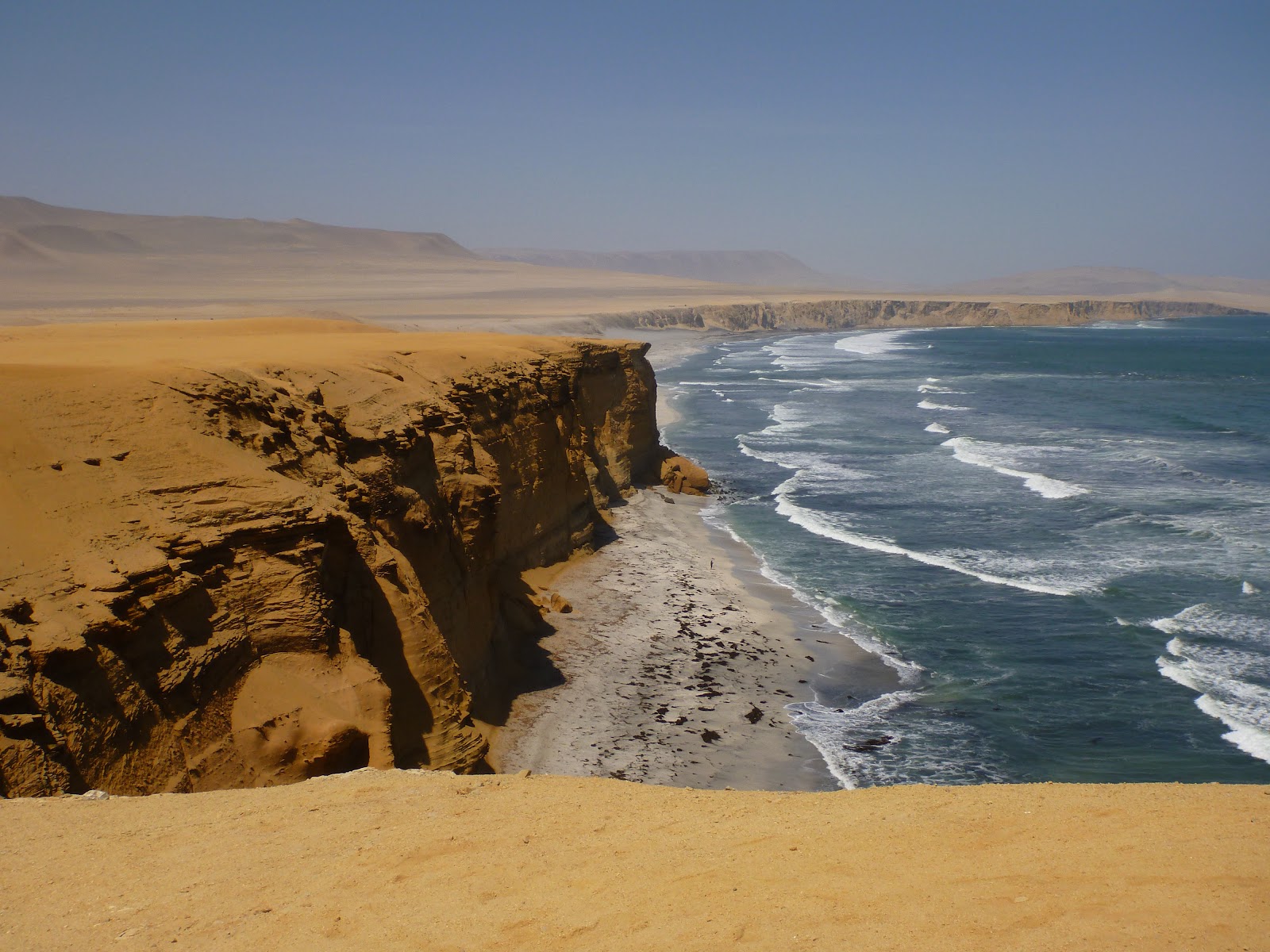
The second part of the day was the national reserve Paracas. The scenery in the reserve is gorgeous. The direct combination of desert and ocean, cliffs and waves, is stunning:


Most of the rocks in the area are of sedimentary origin. There is one volcanic rock, however, and washed out particles from this rock have created this wonderful red beach:


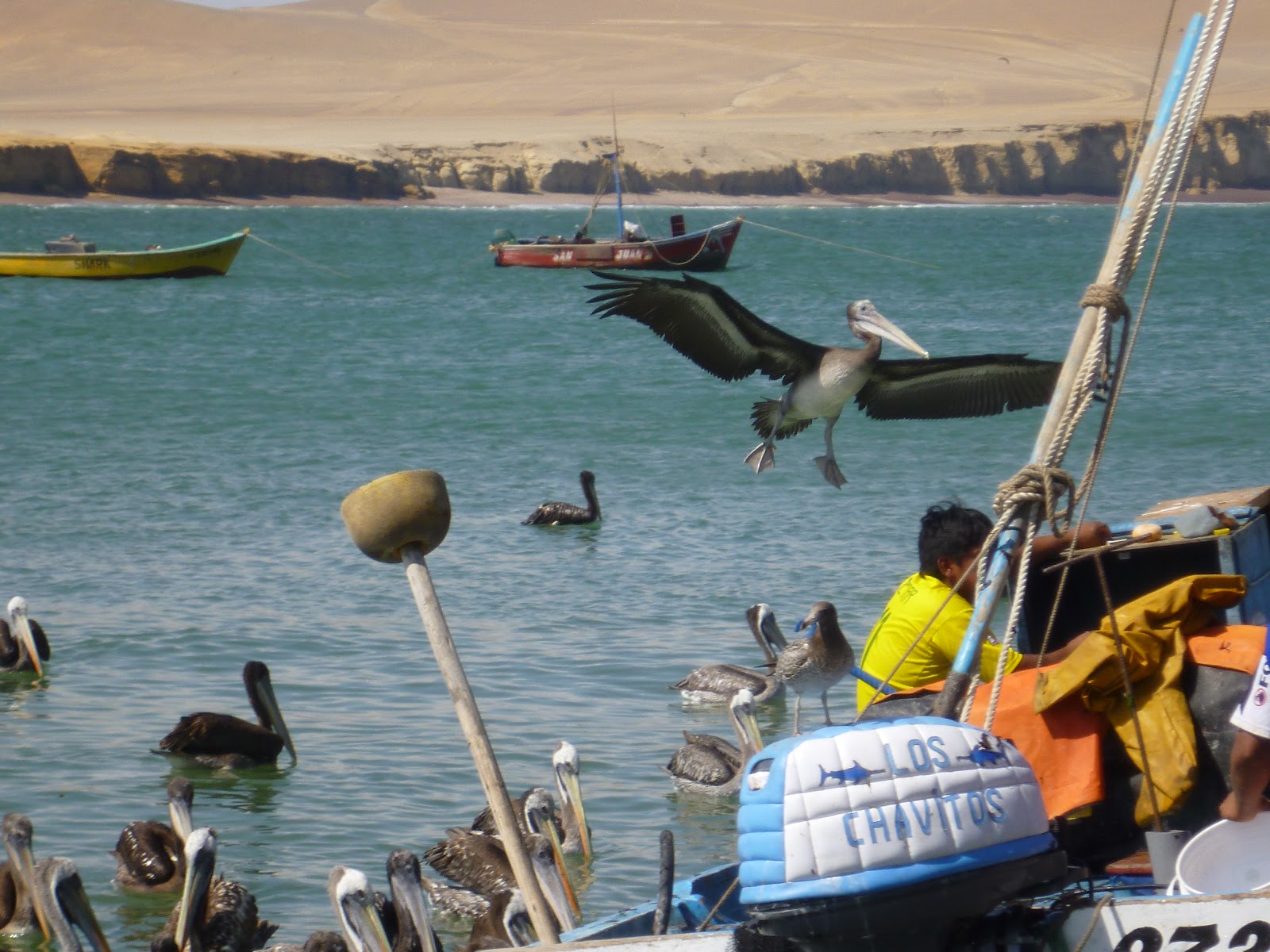
There were many pelicans around again, and I had some time to watch them. I have to say, I really like the way they fly. They look like heavy, slightly clumsy freighters that are not quite sure yet whether they'll keep flying or crash. Whenever they start from water, they pat the surface a few times with their feet to help them along. Their overall impression is so funny that I got to think of them as slapstick birds. Just have a look - aren't they comical?


Monday, April 30, 2012

Day 183: Nazca to Paracas

Since Nazca doesn't really have a lot to offer besides the lines, I decided to make my way to the coastal village of Paracas today. The bus left around noon, so I had plenty of time to visit the Antonini museum of archeology before.

The museum presents photos and exhibits from a number of excavation sites in the Nazca area. What impressed me most was a surprisingly obvious insight. The Nazca seem to have been masters of pottery, leaving behind beautifully decorated pieces like this:


Now, I had seen items like this before, in the museum of pre-Colombian art in Cusco. What hadn't occurred to me then, however, was that they would have needed special tools to produce the delicate paintings. Due to the arid desert climate around Nazca, some of these tools have been preserved perfectly and are now exhibited in the museum:


1500 year old paintbrushes, looking almost new - how crazy is that?

Day 182: Nazca

The first thing I did when I arrived in Nazca was arrange my overflight of the famous Nazca lines. The flights are ridiculously expensive for Peruvian standards - easily recognizable because they, like all ridiculously expensive things in Peru, are priced in US dollars. But this couldn't be helped, got to see the lines!

At Nazca airport, a host of tiny planes was waiting for tourists. Apparently, Nazca line overflights are the only flights happening here. This is the four-passenger Cessna 206 I flew in:


My travel guide, and also the lady at my hostel, had warned against eating anything heavy before the flight, so I only had some orange juice. But this didn't help: the bumpy flight in combination with tight curves and trying to spot things on the ground made everything come out again.
Maybe I should strike "learn to fly" off my bucket list - seems my stomach can't handle small planes.

Under these conditions, it wasn't all that easy to fully appreciate what I saw. But anyway, the lines and figures are amazing. This monkey, for example, is 110 meters wide. No chance to see this from the ground!


The hummingbird, 96 meters. Look at how perfectly parallel the lines are:


You can also see how the figures are connected to a pattern of straight lines and rectangles. These actually make up the majority of the lines. The figures are pretty small in comparison.


The lines were apparently not etched into the ground. All their creators had to do was clean away the top layer of dust and stones to reveal a lower layer of lighter ground. The dry desert climate then did the rest to preserve the lines.

To get an idea how big the figures are, these two - a tree and hands - have a highway and cars as a size reference:


In the evening, I visited the Maria Reiche planetarium, named after a German scientist who spent 60 years of her life in Peru investigating the lines. The show tried to shed some light on the purpose of the lines. Some theories are: a giant calendar that indicates solstices and stars, a method to point to water sources in the region, and open-air temples. However, there doesn't seem to exist a consensus. And as the lines were made in a period of more than 1000 years, it may even be possible that the purpose changed over time. I love a good riddle, but knowing that the solution might be forever lost is somewhat frustrating, isn't it?