I'm not exactly sure why I decided to leave Laos so soon. There would have been more to see in Luang Prabang, and I really liked the climate and slow pace of life in Laos - and I loved the fact that saying 'hello' in Lao forces you to smile (just try saying 'sabaidee' without getting your lips into smiling position, and you'll know what I mean.)
Maybe it was the crappy party hostel that I stayed at that made me want to leave? By the end of my seven nights in Luang Prabang I was really fed up with the crowd of 20-year olds hanging around the hostel comparing their latest getting-drunk adventures.
Whatever the reason, last night I found myself on a bus bound for the Lao-Thai border. In the morning, we arrived in Houay Xai, the border town on the Lao side. After a short tuk-tuk ride we were at the border, got stamped out of Laos and boarded a ferry across the Mekong river that forms the border between the two countries. Immigration on the Thai side was very quick: Thailand is one of the few countries in South-East Asia where Germans don't need a visa.
We arrived in Chiang Mai in the afternoon, and I was pleasantly surprised by my hostel. I had booked one of the more expensive ones - where the reviews consistently said that it was quiet and very definitely not a party hostel. The hostel turned out to have a garden that seemed to be a popular hangout for squirrels, birds and geckos. I was especially happy about the squirrels, and so I chose to hang out with them for the rest of the day, and continue to work on job applications.
Showing posts with label Laos. Show all posts
Showing posts with label Laos. Show all posts
Monday, December 10, 2012
Day 414: More Sights in Luang Prabang
On my last day in Laos, I visited two more of Luang Prabang's famous sights. The first one was Wat Xieng Thong, one of the most important monasteries in Laos. The weather was perfect, and in the bright sunlight the temple with its tiered roof looked especially resplendent.

Inside was a huge golden Buddha along with many smaller ones - the standard interior of many Buddhist temples.

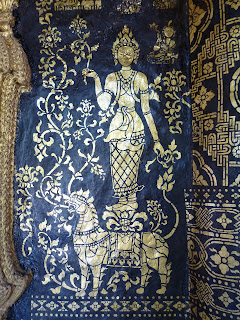
What made this one special were the graceful golden decorations that were painted all over the interior and exterior walls:
The temple's rear wall was painted red and decorated with a huge mosaic tree. Since the temple's name allegedly means something like "golden tree temple," this decoration may well be the reason for the name.

Many of the smaller buildings next to the main prayer hall were also richly decorated, mostly with scenes depicting Lao life (and probably Lao myth and stories as well). This picture shows just a small portion of one building's wall - just imagine how many stories can be told with this kind of decoration if you have the walls of several big temple buildings!

The second place I visited was the ethnographic museum. They had explanations about the different peoples that live in Laos, and displayed many of their traditional dresses. This, for example, is the dress, headdress and jewelry that Akha women traditionally wear:

The museum also explained the marriage customs in Laos. In general, marriages between persons from different peoples are accepted and widely practiced. Some of the peoples have rules that forbid their members to marry within their family, or even within their village. As a consequence, festivals such as the new year celebration and occasions like the end of the harvest are used to meet people (i.e. potential partners) from other villages. According to the museum, marriages in Laos are almost never arranged - an interesting difference to Vietnam, where the practice of arranging marriages seems to be somewhat more common, at least among some of the hill tribes.

Inside was a huge golden Buddha along with many smaller ones - the standard interior of many Buddhist temples.

What made this one special were the graceful golden decorations that were painted all over the interior and exterior walls:

The temple's rear wall was painted red and decorated with a huge mosaic tree. Since the temple's name allegedly means something like "golden tree temple," this decoration may well be the reason for the name.

Many of the smaller buildings next to the main prayer hall were also richly decorated, mostly with scenes depicting Lao life (and probably Lao myth and stories as well). This picture shows just a small portion of one building's wall - just imagine how many stories can be told with this kind of decoration if you have the walls of several big temple buildings!

The second place I visited was the ethnographic museum. They had explanations about the different peoples that live in Laos, and displayed many of their traditional dresses. This, for example, is the dress, headdress and jewelry that Akha women traditionally wear:

The museum also explained the marriage customs in Laos. In general, marriages between persons from different peoples are accepted and widely practiced. Some of the peoples have rules that forbid their members to marry within their family, or even within their village. As a consequence, festivals such as the new year celebration and occasions like the end of the harvest are used to meet people (i.e. potential partners) from other villages. According to the museum, marriages in Laos are almost never arranged - an interesting difference to Vietnam, where the practice of arranging marriages seems to be somewhat more common, at least among some of the hill tribes.

Days 412 + 413: Research Days
Another two days spent reading papers, writing applications and developing my research vision. From now on, I'll omit most of these days from the blog - while I absolutely love doing the work, not having to blog about them is one less thing for me to worry about ;-)
This is one of the cafes in Luang Prabang where I've spent a few hours working - a very agreeable environment, with a nice coffee and a gorgeous fruit platter:

This is one of the cafes in Luang Prabang where I've spent a few hours working - a very agreeable environment, with a nice coffee and a gorgeous fruit platter:
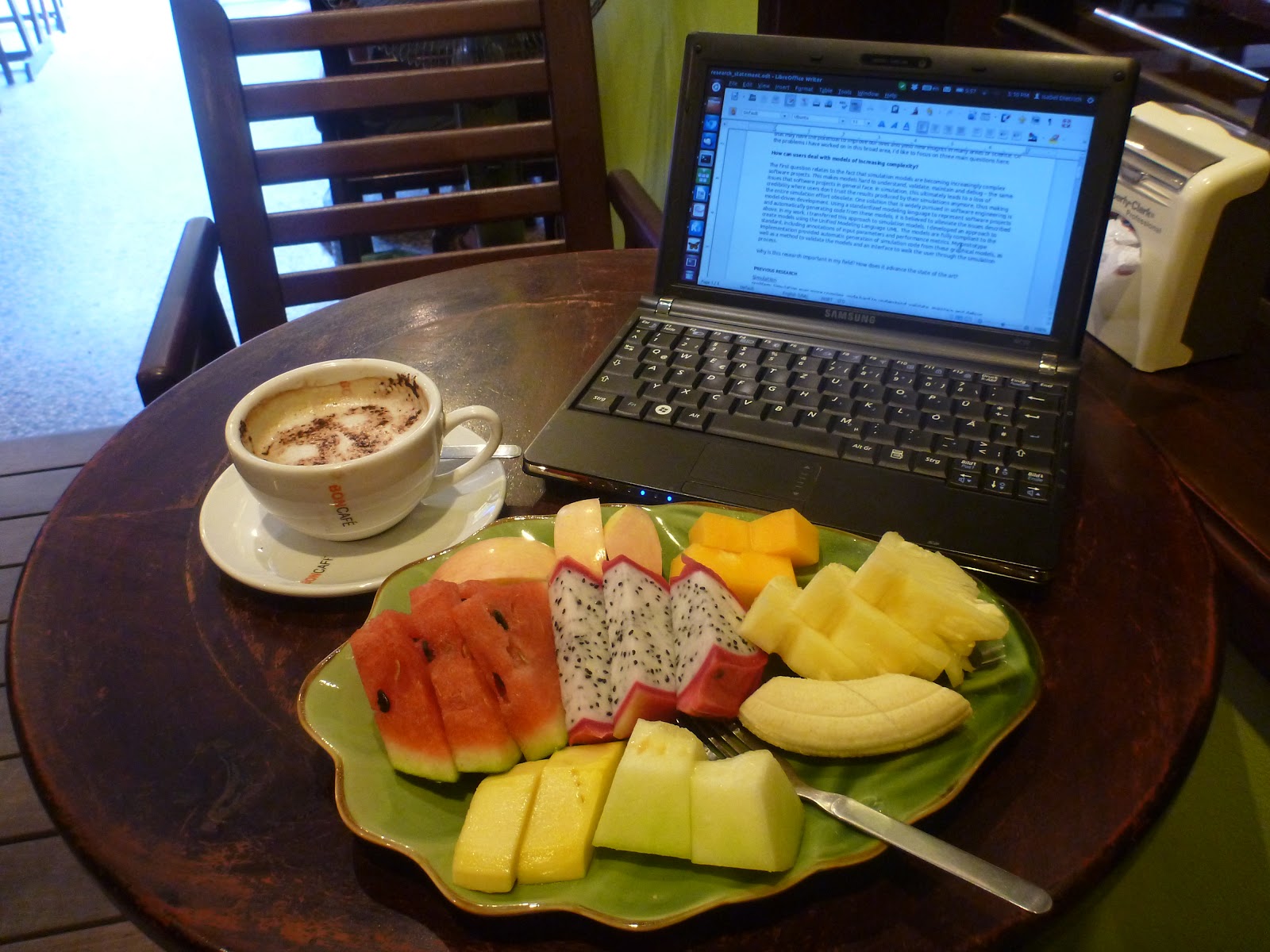
But still: a desk, a good quality desk chair and a bigger screen would definitely improve my situation!
Day 411: Mahout for a Day
Today I did a one-day "mahout experience." The experience at the Elephant Village close to Luang Prabang involved riding on an elephant - on her neck, not in a bench! - and later bathing her, and included lots of information about elephants in general, and elephants in Laos in particular. I learned that elephants in Laos represent a valuable property: depending on the elephant's age, it costs around 15.000 to 20.000 US dollars to buy one. Since elephants eat an insane amount of food (upwards of 200 kilos per day!), it is a common notion that elephants have to earn their own living (and possibly some extra cash for their owners, too). Most commonly, Lao elephants are employed in logging, an extremely hard and strenuous work even for elephants.

The Elephant Village's approach is therefore to buy logging elephants (and hire a few more from families in the region), and give them a job in tourism where they can earn their living with less strenuous work, and fewer working hours per day. When I visited, there were eleven female elephants working in the Elephant Village. They explained that they exclusively work with female elephants. The reason is simple: when the females are in heat, and the males want to mate, it is possible that the female doesn't want to. The resulting disagreement may be carried out in such a way that it might harm tourists that are present at the time. Removing the males from the equation makes the situation safe again.
The elephant lady that I got to ride on was pregnant at the time (don't ask me how she got pregnant when there are no male elephants in the village!) I learned that an elephant pregnancy takes a full 22 months! And here I was, thinking that the nine months it takes humans are quite a long time already...

For the last couple of months of her pregnancy, she won't have to carry tourists around; but during the early stages of her pregnancy she is still expected to work (sound familiar? That's probably because humans made the rules in the Elephant Village.)
The mahouts, or elephant drivers, stay with their elephants throughout their lives and develop a close relationship with them. The strength of this relationship became obvious when the mahout dismounted during our ride to take a few pictures for us: she refused to move forward when the mahout wasn't in sight, and wagged her ears (a sign of contentment) when he reappeared.

After lunch, we got to bathe the elephants. Bathing was quite funny: we put on bathing suits and then rode on the elephant's necks to the river. There, the elephants were told to kneel down and we could work on them with a brush. Apparently the elephants all know a command that tells them to use their trunks to splash water on their backs, and so we all got plenty of water in our faces during the process.

Finally, after saying goodbye to the elephants and mahouts, we took a boat to go to the Tad Sae waterfalls. The waterfalls consisted of a succession of small falls running over rounded rocks, forming small turquoise pools in between.

Unfortunately, the usual afternoon rains set in soon after we arrived, so we didn't really get to swim or enjoy the scenery for a long time. Nevertheless, it was good fun to walk around on the rims of the waterfalls in the time before the rain came.


The Elephant Village's approach is therefore to buy logging elephants (and hire a few more from families in the region), and give them a job in tourism where they can earn their living with less strenuous work, and fewer working hours per day. When I visited, there were eleven female elephants working in the Elephant Village. They explained that they exclusively work with female elephants. The reason is simple: when the females are in heat, and the males want to mate, it is possible that the female doesn't want to. The resulting disagreement may be carried out in such a way that it might harm tourists that are present at the time. Removing the males from the equation makes the situation safe again.
The elephant lady that I got to ride on was pregnant at the time (don't ask me how she got pregnant when there are no male elephants in the village!) I learned that an elephant pregnancy takes a full 22 months! And here I was, thinking that the nine months it takes humans are quite a long time already...

For the last couple of months of her pregnancy, she won't have to carry tourists around; but during the early stages of her pregnancy she is still expected to work (sound familiar? That's probably because humans made the rules in the Elephant Village.)
The mahouts, or elephant drivers, stay with their elephants throughout their lives and develop a close relationship with them. The strength of this relationship became obvious when the mahout dismounted during our ride to take a few pictures for us: she refused to move forward when the mahout wasn't in sight, and wagged her ears (a sign of contentment) when he reappeared.

After lunch, we got to bathe the elephants. Bathing was quite funny: we put on bathing suits and then rode on the elephant's necks to the river. There, the elephants were told to kneel down and we could work on them with a brush. Apparently the elephants all know a command that tells them to use their trunks to splash water on their backs, and so we all got plenty of water in our faces during the process.

Finally, after saying goodbye to the elephants and mahouts, we took a boat to go to the Tad Sae waterfalls. The waterfalls consisted of a succession of small falls running over rounded rocks, forming small turquoise pools in between.

Unfortunately, the usual afternoon rains set in soon after we arrived, so we didn't really get to swim or enjoy the scenery for a long time. Nevertheless, it was good fun to walk around on the rims of the waterfalls in the time before the rain came.

Day 410: Cooking in Luang Prabang
Today I attended another cooking class. Contrary to my previous classes, this one was designed as a full-day course rather than just a few hours leading up to lunch. Our day started with a visit to Luang Prabang's biggest market. The amount of vegetables and greenery available in this market was stunning. This is just one of many vegetable stalls:

Next to all the food stalls, there were a variety of other items on sale, not unlike the selection you'd find in a supermarket: clothes, household items, toys, ... and this:

I'm not sure if I would have guessed what this was only from a visual impression. My sense of smell, however, immediately told me what was in the bags: tobacco! As long as people don't try to burn them, I love the smell of tobacco leaves.
Back in the cooking school, our teacher explained the procedure for the rest of the day: he would demonstrate how to make the dishes - two for lunch, and five for dinner - and we would then cook them independently, with him being available to help if necessary. This is the neat and clean interior of the school - just before we started laying waste to it ;-)

A little while later: success! The two lunch dishes didn't look quite as perfect as those that our teacher had cooked, but tasted excellent. On the left-hand side you can see Luang Prabang salad, and on the right-hand side a dish called Feu Khua, made of fried rice noodles, egg, chicken and vegetables.

After lunch, the cooking continued. Our teacher demonstrated five dishes for dinner, and after tasting them, we each chose three to cook ourselves. Since all five were absolutely delicious, I coordinated with the couple doing the class with me so that we would be able to share and eat all five dishes for dinner.
The dish that I liked best was one whose name is absolutely impossible to pronounce correctly: Kheu Muk Kheua Gup Moo - fried eggplant with pork and a yummy sauce whose main ingredient was oyster sauce. Since the others liked this dish best as well, this was the one dish we both cooked. The two versions are on the top left and right of the picture:

The other dishes were delicious as well, and most of them easy enough to cook at home. I'm looking forward to making some Lao food once I have a home again! Just in case you are wondering about the lack of staples in this picture: the bamboo basket at the bottom of the picture contains sticky rice. This is the standard way of serving sticky rice in Laos and everybody does it this way, from restaurants to people taking their basket with them to work. The people usually use their fingers to make little sticky rice balls and dip them into whatever sauce is available, such as the chili dip at the top of the picture.
The cooking and eating finished just in time for the sunset. During the last few days, I had wanted to climb the hill in the center of Luang Prabang to watch the sunset, but had always missed the right time. Today the timing was perfect, and I started the climb with plenty of time to get to the top. From a little way up, there was a nice view of the main street with the royal palace's temple in the background. Just like every night, the street was closed to traffic, and the sales ladies were just setting up their night market stalls:

On the top of Mount Phousi, I found that everybody else also seemed to think that a hill would be a good place to watch the sunset. The sunset wasn't all that spectacular, but watching the picture-taking crowd was quite funny.


Next to all the food stalls, there were a variety of other items on sale, not unlike the selection you'd find in a supermarket: clothes, household items, toys, ... and this:

I'm not sure if I would have guessed what this was only from a visual impression. My sense of smell, however, immediately told me what was in the bags: tobacco! As long as people don't try to burn them, I love the smell of tobacco leaves.
Back in the cooking school, our teacher explained the procedure for the rest of the day: he would demonstrate how to make the dishes - two for lunch, and five for dinner - and we would then cook them independently, with him being available to help if necessary. This is the neat and clean interior of the school - just before we started laying waste to it ;-)

A little while later: success! The two lunch dishes didn't look quite as perfect as those that our teacher had cooked, but tasted excellent. On the left-hand side you can see Luang Prabang salad, and on the right-hand side a dish called Feu Khua, made of fried rice noodles, egg, chicken and vegetables.

After lunch, the cooking continued. Our teacher demonstrated five dishes for dinner, and after tasting them, we each chose three to cook ourselves. Since all five were absolutely delicious, I coordinated with the couple doing the class with me so that we would be able to share and eat all five dishes for dinner.
The dish that I liked best was one whose name is absolutely impossible to pronounce correctly: Kheu Muk Kheua Gup Moo - fried eggplant with pork and a yummy sauce whose main ingredient was oyster sauce. Since the others liked this dish best as well, this was the one dish we both cooked. The two versions are on the top left and right of the picture:

The other dishes were delicious as well, and most of them easy enough to cook at home. I'm looking forward to making some Lao food once I have a home again! Just in case you are wondering about the lack of staples in this picture: the bamboo basket at the bottom of the picture contains sticky rice. This is the standard way of serving sticky rice in Laos and everybody does it this way, from restaurants to people taking their basket with them to work. The people usually use their fingers to make little sticky rice balls and dip them into whatever sauce is available, such as the chili dip at the top of the picture.
The cooking and eating finished just in time for the sunset. During the last few days, I had wanted to climb the hill in the center of Luang Prabang to watch the sunset, but had always missed the right time. Today the timing was perfect, and I started the climb with plenty of time to get to the top. From a little way up, there was a nice view of the main street with the royal palace's temple in the background. Just like every night, the street was closed to traffic, and the sales ladies were just setting up their night market stalls:

On the top of Mount Phousi, I found that everybody else also seemed to think that a hill would be a good place to watch the sunset. The sunset wasn't all that spectacular, but watching the picture-taking crowd was quite funny.

Day 409: Luang Prabang
Today, I got up at 5:30 in the morning to witness the daily alms giving ceremony. This ceremony is an event where monks walk on a fixed route through Luang Prabang and local people provide them with food. Since monks are forbidden to cultivate or prepare their own food, they depend on the generosity of lay people for their sustenance. In return, giving to monks is one way for Buddhists to accumulate good karma or merit and is therefore of some importance to lay Buddhists.
For the ceremony, lay people bring a container of food and then kneel on the side of the road. The monks pass by, carrying their own, initially empty, containers. The lay people then put some amount of their food into each monk's container.

Back home, it was very rare to see a monk or nun on the street. In Laos monks are a very common sight. Their bright orange robes stand out, of course - much more so than the brown or black robes of Christian monks. I wonder if there are really more monks in Laos than in Europe, or if they are just more present on the streets, and more visible?
Since the alms ceremony was over after about an hour, I went back to bed to get some more sleep. In the afternoon, I went to visit the national museum. Wait - national museum? Hadn't I just seen a national museum in Vientiane? Apparently Laos has more than one national museum. But while the one in Vientiane dealt with history, the one in Luang Prabang consisted of the old royal palace and its furnishings. Photography wasn't allowed inside this museum either, but it was much more beautiful than its Vientiane counterpart - full of splendor and rich decorations, just as you would expect of a royal palace. There was a temple on the palace grounds whose outer decorations were just as splendid as the palace's interior:

For the ceremony, lay people bring a container of food and then kneel on the side of the road. The monks pass by, carrying their own, initially empty, containers. The lay people then put some amount of their food into each monk's container.

Back home, it was very rare to see a monk or nun on the street. In Laos monks are a very common sight. Their bright orange robes stand out, of course - much more so than the brown or black robes of Christian monks. I wonder if there are really more monks in Laos than in Europe, or if they are just more present on the streets, and more visible?
Since the alms ceremony was over after about an hour, I went back to bed to get some more sleep. In the afternoon, I went to visit the national museum. Wait - national museum? Hadn't I just seen a national museum in Vientiane? Apparently Laos has more than one national museum. But while the one in Vientiane dealt with history, the one in Luang Prabang consisted of the old royal palace and its furnishings. Photography wasn't allowed inside this museum either, but it was much more beautiful than its Vientiane counterpart - full of splendor and rich decorations, just as you would expect of a royal palace. There was a temple on the palace grounds whose outer decorations were just as splendid as the palace's interior:

Friday, November 30, 2012
Day 408: Research Day
Today was another day I dedicated to catching up on research and drafting ideas for my future there. I am making progress, but much more remains to be done - which is a good thing, because I rather enjoy it.
I am still struggling with two things that make my undertaking hard at times. First, I find that I constantly have to justify "doing nothing" to fellow travelers - and to myself. While I can explain quite well what I am doing and why, some part of me seems to think that nevertheless I should achieve more in terms of traveling.
And second, it is difficult to find suitable places to work. Some hostels have lovely sitting areas with proper chairs and tables, but most of them cater to the party crowd with a bunch of sofas and loud music playing all day. The dorms themselves are quieter, but sitting on a bed always makes me sleepy. Coffee shops are among my favorite places to escape hostel noise, but I don't really want to sit there for longer than two to three hours. So in essence, every working day is also a quest for a quiet space to work in.
I am still struggling with two things that make my undertaking hard at times. First, I find that I constantly have to justify "doing nothing" to fellow travelers - and to myself. While I can explain quite well what I am doing and why, some part of me seems to think that nevertheless I should achieve more in terms of traveling.
And second, it is difficult to find suitable places to work. Some hostels have lovely sitting areas with proper chairs and tables, but most of them cater to the party crowd with a bunch of sofas and loud music playing all day. The dorms themselves are quieter, but sitting on a bed always makes me sleepy. Coffee shops are among my favorite places to escape hostel noise, but I don't really want to sit there for longer than two to three hours. So in essence, every working day is also a quest for a quiet space to work in.
Day 407: To Luang Prabang
Another day, another long bus ride: the bus to Luang Prabang in northern Laos took about 6 hours. Since the road is very bumpy and winding, buses run only during the daylight hours. While I appreciate the thinking behind this, it also meant that the better part of the day was spent crammed in a minivan, being catapulted out of the seat at regular intervals.
We passed many small mountain villages on the way. Most of the villages had a single central well where people were taking showers and filling their water canisters. Plumbing? Running water? Hot showers? All non-existent in these villages.
In the late afternoon, I walked around Luang Prabang's historical center for a while. The town is located on the banks of the Mekong river - an old acquaintance that I had already seen in Vietnam. When I got there, all the tourist boats were already parked for the night:

This is one of many temples that are scattered throughout the center:

A famous attraction in Luang Prabang is its night market. Every evening, the main street running through the historical center is roped off and hundreds of stalls are erected that sell mainly souvenirs for tourists. In some of the side streets there is excellent street food, and so I indulged in a big dinner that cost only 10.000 Kip - about 1 euro.

We passed many small mountain villages on the way. Most of the villages had a single central well where people were taking showers and filling their water canisters. Plumbing? Running water? Hot showers? All non-existent in these villages.
In the late afternoon, I walked around Luang Prabang's historical center for a while. The town is located on the banks of the Mekong river - an old acquaintance that I had already seen in Vietnam. When I got there, all the tourist boats were already parked for the night:

This is one of many temples that are scattered throughout the center:

A famous attraction in Luang Prabang is its night market. Every evening, the main street running through the historical center is roped off and hundreds of stalls are erected that sell mainly souvenirs for tourists. In some of the side streets there is excellent street food, and so I indulged in a big dinner that cost only 10.000 Kip - about 1 euro.

Day 406: Kayaking in Vang Vieng
Vang Vieng is famous for its scenery and the range of outdoor activities available. The most famous of these activities is tubing - floating down the river while lounging in an inner tube. The reason why this was immensely popular in Vang Vieng were countless riverside bars where people would take breaks to get drunk. After more than 20 tourists died in subsequent accidents in 2011, most of the bars are now closed. I'm not quite sure what will happen to the bloated tourist infrastructure in Vang Vieng once the backpacker party crowd realizes there is no more drunk tubing to be had here...
Anyway, since tubing sounded rather boring, I opted to do a kayaking trip down the same river, but starting much further upstream. Before we got into the kayaks, we visited Loup cave, one of many caves in the region. On the way to the cave, the guide suddenly pointed out a group of trees and asked if I knew what they were. I didn't - because I had never seen teak trees before. The leaves were huge, about 30 cm long and almost as wide.

The cave was a fantastic experience. Aside from two wooden ladders for the initial climb into the cave, there was no infrastructure inside: no lights, no paths, no roped-off areas where the ground suddenly disappears. We were provided with head lamps by our guide, and he also showed us where best to step. I loved discovering the rock formations in my lamp's dim light. I never had the overall views you can see in the following pictures - they were only possible thanks to my camera's flash.


It had been raining on and off all day, but just in time for our kayaking, the rain stopped for good. The clouds lingering on the mountains resulted in really beautiful views:

Anyway, since tubing sounded rather boring, I opted to do a kayaking trip down the same river, but starting much further upstream. Before we got into the kayaks, we visited Loup cave, one of many caves in the region. On the way to the cave, the guide suddenly pointed out a group of trees and asked if I knew what they were. I didn't - because I had never seen teak trees before. The leaves were huge, about 30 cm long and almost as wide.

The cave was a fantastic experience. Aside from two wooden ladders for the initial climb into the cave, there was no infrastructure inside: no lights, no paths, no roped-off areas where the ground suddenly disappears. We were provided with head lamps by our guide, and he also showed us where best to step. I loved discovering the rock formations in my lamp's dim light. I never had the overall views you can see in the following pictures - they were only possible thanks to my camera's flash.


It had been raining on and off all day, but just in time for our kayaking, the rain stopped for good. The clouds lingering on the mountains resulted in really beautiful views:

Day 405: To Vang Vieng
Vientiane may be the capital of Laos, but that doesn't change the fact that it's a small town with a limited number of things to see. So today I took a bus northward, to the even smaller town Vang Vieng. I was quite annoyed that it is next to impossible to book accommodation online in Laos - walking around town with my backpack, I seem to be unable to make sensible housing decisions. I'm definitely not the kind of backpacker who is comfortable lugging a pack through town while comparing guesthouses.
To make up for the stress of having to find a guesthouse, I treated myself to a traditional Lao massage in the evening. Massages are incredibly cheap in Laos: I paid 70.000 Kip (about 7 euro) for a 90-minute massage. On the scale of painfulness, Lao massages range somewhere between Swedish and Thai massages. A very nice touch was that the massage included the application of hot herbal stamps that further relaxed the muscles after the painful bit ;-)
To make up for the stress of having to find a guesthouse, I treated myself to a traditional Lao massage in the evening. Massages are incredibly cheap in Laos: I paid 70.000 Kip (about 7 euro) for a 90-minute massage. On the scale of painfulness, Lao massages range somewhere between Swedish and Thai massages. A very nice touch was that the massage included the application of hot herbal stamps that further relaxed the muscles after the painful bit ;-)
Day 404: Pha That Luang
When I woke up in the morning, it was pouring down - so much, in fact, that it poured straight through parts of the hostel's roof. I didn't let the weather irritate me, ate breakfast and worked on my applications for a while. Around noon, the rain and clouds had completely cleared away, and so I used the perfect weather for a visit to the Lao national symbol: Pha That Luang stupa. This is the stupa seen from the huge open square outside its main gate:

To the left and right of the stupa were temple buildings that were almost as splendid as the golden stupa itself, for example this one:

To be able to enter the stupa compound, every woman had wear a traditional Lao skirt. Luckily, there was a skirt rental nearby that also helped with dressing. The result, however, was that I wore two additional layers of cloth over my long trousers - on a very hot and humid day. I was sweating like a pig, but I think the closeup view of the magnificent stupa was worth it ;-)

On the way back to my hostel, I saw this world peace gong in a small park. Next to (probably) all of the world's flags, the gong was also decorated with symbols for the world's religions on the inner circle:


To the left and right of the stupa were temple buildings that were almost as splendid as the golden stupa itself, for example this one:

To be able to enter the stupa compound, every woman had wear a traditional Lao skirt. Luckily, there was a skirt rental nearby that also helped with dressing. The result, however, was that I wore two additional layers of cloth over my long trousers - on a very hot and humid day. I was sweating like a pig, but I think the closeup view of the magnificent stupa was worth it ;-)

On the way back to my hostel, I saw this world peace gong in a small park. Next to (probably) all of the world's flags, the gong was also decorated with symbols for the world's religions on the inner circle:

Day 403: Vientiane
I spent my first full day in Vientiane exploring museums and temples. My first stop was the Lao National Museum which, I have to say, was one of the worst national museums I've ever seen. One of the reasons for this may have been that English descriptions were available for only on about a third of all exhibits, making it appear a little disorganized and confusing for a non-Lao-speaker. Another reason was the feeling of propaganda that permeated parts of the museum: especially the section on 20th century history seemed to present events very much from the communist party's viewpoint. As a consequence, the US were always referred to as "imperialist", as in "US imperialist government", or "US imperialist army", etc.
The museum's worst part, however, was the current developments section. From its makeup and the few dates I saw on descriptions, the section's last update was more than twenty years ago. The section basically consisted of one display case for each ministry. Above the display case were pictures of the ministry's members, and the display cases had a few seemingly random exhibits: the ministry for health had an assortment of pills; a few others had selections of old reports; the ministry for trade had some silk samples; and so on. Despite (or maybe even because of?) my growing feeling of bewilderment, I found it quite interesting to wander through the museum, and the propaganda parts were almost funny.
Next, I walked to Patuxay, a building resembling the Arc de Triomphe. From afar, the arch and the surrounding park look quite nice, but once you get closer it gets increasingly obvious that the building is a concrete monster that lacks a few finishing touches. Ironically enough, that is almost exactly the description you can read on a sign inside the arch.

After lunch, I went to visit Hor Phakeo, a temple-turned-museum that exhibits Buddha statues in sizes from 2 centimeters to 5 meters. The building's layout and decoration are typical for Buddhist temples in Laos - beautiful, isn't it?

The gallery running around the temple's single room was decorated by Buddha statues placed in regular intervals. There were many local people who stopped to pray at every single one of them.

Directly opposite Hor Phakeo was Sisaket, the oldest temple in Vientiane. All the other old temples were destroyed in one of many wars and invasions. The reason why Sisaket survived is simple: it was used as administrative building by the occupying army.

Sisaket also houses many, many Buddha statues, but in a separate gallery that surrounds the temple building at a few meters' distance. All of the statues were clothed with an orange scarf - orange being the traditional color of monks' clothing.

Tuesday, November 27, 2012
Day 402: To Vientiane, Laos
My trip from one nation's capital (Hanoi) to another's (Vientiane) was a long one: the sleeper bus took around 20 hours, plus another two hours getting from my hostel in Hanoi to the bus station. The trip was quite enjoyable actually - not least because the Vietnamese sleeper buses are the most comfortable ones I've experienced so far for overnight trips: their seats recline to about 150 or 160 degrees, which makes it possible to get a good night's sleep.
We arrived at the border at around 5:30 in the morning but were left to sleep until the border opened at 7 am. The border formalities were quick and painless, provided you were equipped with the right amount of US dollars and passport photos for the Laos visa on arrival.
My first impressions of Laos were the beautiful mountain scenery and the scorching heat at our lunch break.

Also, the houses in Laos seemed to be much bigger than Vietnamese houses. This might be correlated to Laos' population-to-land ratio: Laos is about two thirds of Vietnam's size, but has less than one tenth of its population. This means there is much more land to go around, which allows for bigger houses. There also seemed to be many more cars around. This could be due to a different taxation policy in Laos: with the 200% tax on car purchases in Vietnam, most people can't afford to buy a car; a different taxation in Laos would naturally lead to more cars.
We arrived at the border at around 5:30 in the morning but were left to sleep until the border opened at 7 am. The border formalities were quick and painless, provided you were equipped with the right amount of US dollars and passport photos for the Laos visa on arrival.
My first impressions of Laos were the beautiful mountain scenery and the scorching heat at our lunch break.

Also, the houses in Laos seemed to be much bigger than Vietnamese houses. This might be correlated to Laos' population-to-land ratio: Laos is about two thirds of Vietnam's size, but has less than one tenth of its population. This means there is much more land to go around, which allows for bigger houses. There also seemed to be many more cars around. This could be due to a different taxation policy in Laos: with the 200% tax on car purchases in Vietnam, most people can't afford to buy a car; a different taxation in Laos would naturally lead to more cars.
Subscribe to:
Posts (Atom)