Showing posts with label Mexico. Show all posts

Wednesday, October 10, 2012

Day 351: Goodbye, Mexico! Goodbye, Americas!

On my last half day in Mexico and the Americas, I went to visit the Castillo de Chapultepec, and the national history museum that is located there. In my experience, it usually makes more sense to visit a history museum on the first day in a country instead of the last; but since I didn't enter Mexico through the capital I couldn't really help it.


The history museum covered Mexican history starting with the Spanish conquest - I'd already seen all things pre-hispanic in in the anthropology museum.

I learned that Mexico was one of many countries that used Spain's troubles at the beginning of the 19th century - when it was invaded by Napoleon - as an opportunity to declare their independence. Isn't it fascinating that almost all South and Central American countries started their independence movements around the same time? Mexico declared independence in 1810, so - like many of the South American countries I've visited before - it just celebrated its 200th birthday two years ago. In contrast, the Philippines, also colonized by the Spanish, started their independence war only at the very end of the 19th century.

Right at the beginning of the exhibition, the museum had a sculpture representing the Mexican coat of arms: an eagle devouring a snake while sitting on a cactus.


For a long time, the castle served as residence for Mexico's rulers; the conversion into a museum is relatively recent. As I discovered, there are two parts to the museum: one part explains Mexican history, while the other showcases some of the residence's rooms with their original furnishings. This, for example, was a dining room:


From the castle's rooftop terrace, there were great views of Mexico City's skyline. The tree-covered area in front is the Bosque de Chapultepec, the largest park in Mexico City.


In the afternoon, it was time for me to say goodbye to the Americas. After almost an entire year spent in Spanish-speaking countries, I've really gotten used to the comfort that comes with speaking the language of the country I was traveling in. But regardless of comfort: I'm curious to finally see more of Asia in the coming weeks!

Sunday, October 7, 2012

Day 350: Anthropology and Art in Mexico City

I dedicated this day almost entirely to the National Museum of Anthropology in Mexico City. I had heard that the museum was huge and almost impossible to visit in its entirety in one go, so I decided to just go there in the morning and see how far I got before my head threatened to explode.

The museum focuses on all the indigenous cultures in Mexico, grouped by geographical region and time. For ease of reference, time spans were given in terms of three phases - preclassic (up to 100 AD), classic and postclassic (after 900 AD). On the ground floor, the museum had exhibits from the pre-hispanic civilizations, while the first floor had exhibits from the peoples who live in the same geographical regions today.

As I had feared, the museum was much too big. There were too many exhibits and too many explanations to read. Just have a look at the main part of the Aztec exhibition to get an impression:


Luckily, from my earlier visits to archaeological sites, I already knew about some of the cultures and didn't have to read every single bit. One new thing I learned was that in this part of the world, organized religion seems to have been invented some time between 1800 BC and 100 AD - the same period of time as in other parts of the world. Strange, isn't it?

As you would expect from a big museum in a nation's capital, they snatched up some of the best archaeological finds from around the country. For example, this was the only place in Mexico where I saw some of the old writings, called codices, on display. This is an Aztec one:


The Maya especially kept excellent records of their history, but unfortunately most of the codices were destroyed by the Spaniards. This is one of the very few remaining ones:


In the Maya section of the museum, they also had the richly adorned sarcophagus of Pakal, ruler of Palenque. But wait... hadn't I seen that sarcophagus before? I had, in fact, when I was visiting Palenque: the site museum there also had the sarcophagus. Neither of the two museums said that their version was a replica. But one of them has to be... if they care this little about fooling the public, I wonder how many exhibits in this or other museums were just replicas instead of the real thing?

The museum also displayed a great feather headdress that was supposedly worn by the last Aztec ruler Moctezuma II when he went to greet the Spanish conqueror Hernán Cortés:


Another part of the museum dealt with the Olmec, considered to be the first civilization in Mexico. The biggest trademark of the Olmec were the colossal stone heads they made:


After covering all of downstairs, I went upstairs to check out the exhibition about current-day indigenous peoples. The exhibition was started with this tree, representing the diversity of today's indigenous people in Mexico:


I was already quite tired at this point in my visit, so I didn't really pay much attention to the rest of the exhibition. All I managed was to walk through, just for the satisfaction of having seen everything ;-)

After a break in the afternoon, I felt up to one more museum visit. As a contrast, I picked something small and non-historic: the Frida Kahlo museum. The museum is located in a house called Casa Azul, which was the home of Frida Kahlo and her husband Diego Rivera for many years.


The museum had some rooms with artwork created by Frida and Diego, and a few more rooms exhibiting personal items from their lives. Especially Frida's life is quite a tragic story - I suggest you watch the movie Frida if you want to know more.

In the evening, I strolled around in the vicinity of the Zócalo to find something to eat. A short while after I had sat down in a restaurant, a demonstration went down the street just outside the window I was sitting at. The people, mostly the younger half of the population, were demonstrating against the planned labor law reform.


The labor laws are apparently decades old and in definite need of reform; but as with governments worldwide, the Mexican one doesn't seem to have the the common laborer's interests in mind. The reform is supposed to combat unemployment and create new jobs, but people fear that all it will do is outsource jobs and lower salaries.

When I had finished eating, I went down the street to look at the demonstration's aftermath. It seems that the police had covered all the building facades with metal sheets - certainly in anticipation of people spraying slogans on every flat surface available.


The demonstration was still ongoing when I arrived at the Zócalo. Everyone was listening to someone giving a speech in front of the brightly lit government palace.


If you don't look closely, you might think that there was an Italian flag flying over Mexico City. Indeed, when I first came to Mexico and was looking for a restaurant I had wondered about the multitude of 'Italian' restaurants - and the lack of Mexican ones. Later on, I learned that the colors in the Mexican flag are darker than the Italian ones, the proportions of the flag are different, and, of course, there is the Mexican coat of arms in it. But apart from that, the two flags really do look similar ;-)

Day 349: Teotihuacan

Today I made a day trip to the last pre-hispanic city ruins on my schedule for Mexico: Teotihuacan. While the ruins of Tenochtitlan - the ones Mexico City is built upon - are quite new, Teotihuacan is much older. Construction started about 100 AD, and the city was abandoned around 700 AD. But since later pre-hispanic civilizations still seemed to regard the site as sacred, there wasn't as much pillaging and looting going on, so that the major buildings at least are quite well preserved.

According to some theories, the city was built to represent the creation of the universe: two big avenues dividing the city into four sectors corresponding to the four corners of the world. Aztecs in later days also thought of Teotihuacan as a sacred place, treating it as the place where the fifth sun was born.

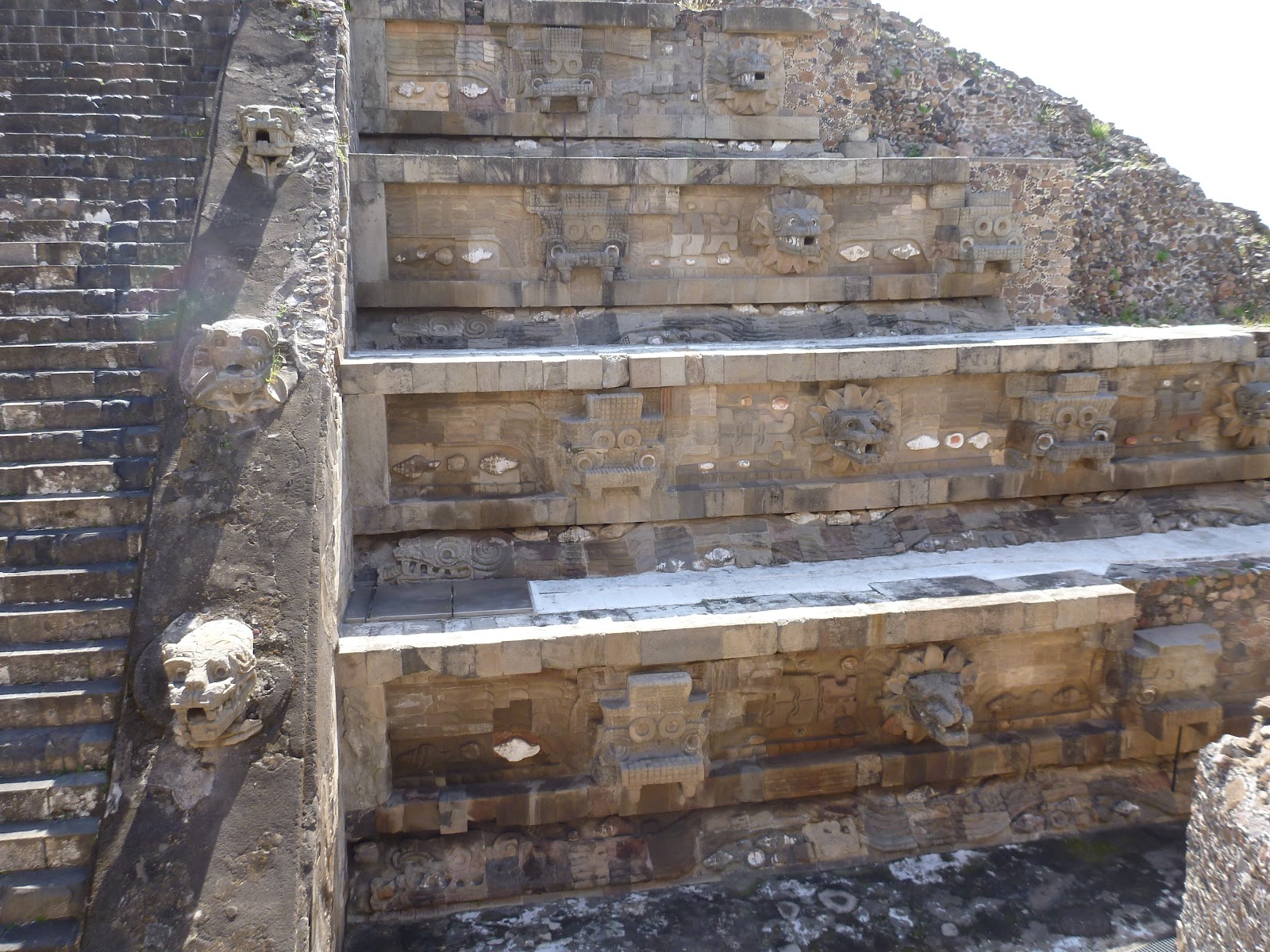
Teotihuacan is another site with more than one layer on some of the buildings. One example is the temple of the feathered serpent, or Quetzalcoatl. The temple walls are beautifully decorated, and I'm guessing that the reason why the decorations are so well preserved is that there used to be another layer on top of it.


The two biggest buildings in Teotihuacan are the temple of the sun and the temple of the moon. The temple of the sun is the third-largest pyramid in the world, with a base that is more than 200 meters long. Since the pyramid isn't very high compared to the size of its base, it does look a little clumsy. The top level was being worked on when I visited, so I had to stop climbing a little below; but even so, there were enough steps to climb to get out of breath.


But there was a very nice reward: a beautiful overview of the entire city, and especially the temple of the moon. The temple of the moon is much better proportioned, and thus looks much more graceful:


The temple of the moon was also open to climb, with the topmost part roped off again. Still, the view, looking down along the Avenue of the Dead, was amazing:


In some of the smaller palaces in Teotihuacan, wall paintings have been conserved that show what a colorful city Teotihuacan must have been. This, for example, is the inner courtyard in the palace of Quetzalpapalotl:


The carvings on the columns depict hummingbirds and owls. Next door, in the patio of jaguars, there are murals that show - surprise - jaguars:


And a little further still are paintings of birds, water and flowers:


There was also a museum on site that exhibited a collection of things found among the ruins: mostly pottery, jewelry, and skeletons of people that were sacrificed when the construction of a new building was started. One of the stranger exhibits was a selection of jewelry that was modeled after human teeth:

Thursday, October 4, 2012

Day 348: Downtown Mexico City

It just so happened that my first full day in Mexico City today was a Sunday - Sunday being the day when most museums are free to visit. For archaeological sites, this applies only to Mexican citizens, so I did have to pay one entrance fee. But the rest of the day was completely free. Amazing! The only downside was that some of the museums were a little busier than I would have wished for - but who am I to complain, entrance was free after all.

My first stop in the morning was the Templo Mayor. The temple was one of the main temples in the Aztec city of Tenochtitlan, and it is located in the middle of downtown Mexico City, right next to the cathedral and the Zócalo. While a big archaeological site in the middle of a city with several million inhabitants seems a little unusual, it is only logical if you think about it: when the Spanish defeated the Aztec in the 16th century, they wanted to subjugate the Aztec as quickly and thoroughly as possible. What better way than to dismantle Aztec buildings and erect your own ones right on top of them? And the site of the most important temples would of course be the first choice as a building spot for your cathedral, wouldn't it? Well, that seems to have been pretty much what happened.

During construction work in the city center, there had always been findings of archaeological material; however, the large-scale excavation of Templo Mayor was only started in 1978, when the newest find was somewhat larger and more spectacular than the previous ones: a huge disk about three meters in diameter, depicting the moon goddess Coyolxauhqui.


As many Aztec buildings, Templo Mayor seems to have been a constant work in progress. Each new ruler decided to enlarge the temple in some manner. Some only reconstructed the main facade, while others encased the existing temple in an entirely new layer. Archaeologists have found seven layers so far - keep in mind that the temple was in use for only about 200 years, from its construction in the 14th century to Spanish conquest in the 16th century. These are two of the excavated layers:


This was one of the outermost layers, featuring two big serpent heads. If you look closely, you can see that there is some of their original coloring left:


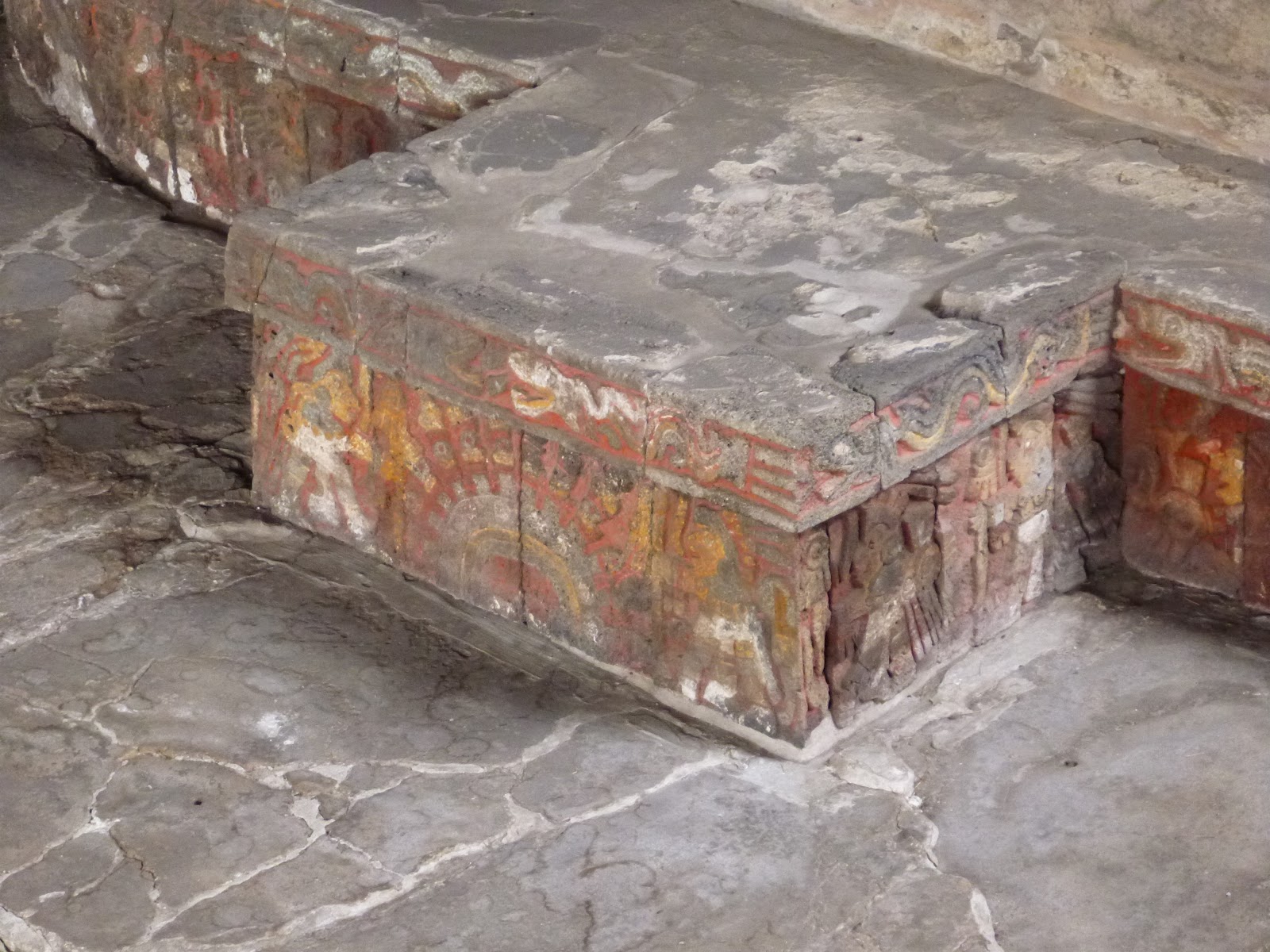
Another part of the temple was a room with benches running around its sides. All the sockets were painted with bright, colorful pictures... showing scenes of human sacrifice, mostly. But hey, at least there were some bright paintings to go along with the sacrificing, weren't there?


Besides part of the temple buildings, there were also some statues that survived the centuries. One of them was this figure, called a chak-mool. I had already seen chak-mools in Maya ruins like Chichén Itzá. Nobody seems to be really sure what these figures represent, however. Probably either a deity or a ruler of some kind, but why he is always shown reclining and holding a pot is quite unclear.


In the temple, I also learned that Mexico City is sinking. The reason is basically a combination of heavy buildings and over-usage of groundwater, and the effect is that in the 20th century alone, parts of Mexico City have sunk about nine meters. Just imagine the effects this may have on things such as buildings, streets - and subways. The softness of the ground may have been another reason why the Aztecs built layer over layer on their temple: just another way to make sure the temple stays above the ground ;-)

Just across the street from Templo Mayor is the government palace. The building is open to the public, and there are some great wall painings to be seen in the second floor. As far as I know, most of them were done by the Mexican painter Diego Rivera; this one adorning the main stairwell is one of them:


After this, I went to visit the Palacio de Bellas Artes - the fine arts palace. The palace, apart from being a great building in itself, houses a museum and a theater. I had checked online to see if there was something interesting and affordable going on in the theater, and found that there was to be a free concert at noon today. I arrived at about 11:30, hoping there would still be seats left - and there were! So I got to enjoy this beautiful theater from the inside:


And, of course, the concert! I believe I'd never before seen a symphonic orchestra live on stage. On TV yes, of course, but I'd never actually been there. The orchestra played four pieces by contemporary Mexican composers - and three of the four were even present in the theater (the fourth couldn't attend, unfortunately, having passed away earlier this year.)

Of the four pieces, I instantly loved the third one, a very lively piece by Javier Álvarez called Metro Chabacano. Thanks to modern technology, the link on the title goes to YouTube where you can have a listen :-)

Another of the pieces was Imágenes del Quinto Sol by Federico Ibarra. In the theater, I had the impression that this was a rather monumental, even apocalyptic piece, but I think the part that is online is one of the less apocalyptic parts. And, of course, the concert included only the music, no dancers.

After the concert, I explored the museum in the Palacio de Bellas Artes. There were quite a few wall paintings and an exhibition about a stage designer, but the real highlight was the building itself. Check it out - isn't it stunning?


My last stop for the day was the modern art museum. The museum was housed in another beautifully designed building, albeit in a completely different style from the fine arts palace. Even the stairwell had some artwork:


The modern art museum is located in a huge park, the Bosque de Chapultepec, or forest of Chapultepec. On my way back to the metro, I found a crowd gathered around a rather nondescript tree - until I saw that the tree wasn't the reason for the crowd, but rather this cute Mexican gray squirrel eating a nut:


Monday, October 1, 2012

Day 347: To Mexico City

So today it finally arrived: the day I made my way to the last city I'm visiting in the Americas (for now, at least). Since the bus trip from Oaxaca was a mere six hours long, I decided to go during the day - no chance to get a decent night's sleep in in just six hours. Consequently, I got to enjoy some more Mexican landscape:


Arriving in Mexico City, I was surprised that the traffic didn't seem bad at all. The bus station I arrived at - Mexico City has four - was within four metro stations of the main square downtown, so we had to pass through a good part of the city to get there. However, we made it without any signs of traffic jam. The next surprise was that the air pollution didn't seem so bad either. I had read terrible things about the air in Mexico City, but so far the big smog hasn't arrived.

Much to my delight, I discovered that Mexico City has a wonderful metro system. Pretty much everything is reachable by metro: all the bus terminals, the airport, downtown, and everything in between. And it is extremely cheap, too: one trip costs 3 pesos - 18 euro cents.


When I got to my hostel, it was already quite late, so the only thing I ended up doing in Mexico City today was a visit to the Zócalo - the main square. The buildings surrounding the square were all decorated in Mexican colors - left over from the independence day celebrations, I guess.


On the Zócalo, I also found some tasty street food - Tlayudas I think they're called. Somehow, even the food ended up being decorated in Mexican colors ;-)

Day 346: Cooking à la Oaxaqueña


To know more about Mexican food, I decided to take a cooking class today. As it turned out, I was the only student - watched over and instructed by two cooks :-)

First I had to decide which meals to cook. Since I was the only student, I had to make all the decisions myself - but as it turned out, I decided well. Maybe the soup choice could have been better, but all the other dishes were excellent. This is what we made:


The second step after deciding on the dishes was visiting the market to buy the ingredients. Of the several markets in Oaxaca, we went to the Sanchez Pascua market which was only a few blocks away. Everything in these markets is organic and grown in the countryside surrounding Oaxaca. The ladies from the farms come to the market only when they have something to sell; so everything that is sold is in season and freshly harvested.

Something that really impressed me in the market were how many different types of dried chili are available in Mexico. Back home, they only ever seem to sell one type - chile de árbol - in tiny little bags. Here, the situation is a little different:


Of all these - as far as I've tried them - chipotles are my favorites. Chipotels are jalapeños that have been dried over smoke. What an excellent taste!

After the market, we went back to the kitchen and started cooking. I have to say - the cooking experience is quite pleasant when you're assisted by two real chefs who prepare the right quantities of everything on nice little plates and take care that your food doesn't burn ;-)

The first step was making tortillas. This is surprisingly easy: you just take a small handful of dough - the ready-made dough can be bought in the market - and put it into the tortilla press. The press is really only two pieces of wood or metal with a lever attached that squishes a ball of dough into the flat, round shape a tortilla is supposed to have. 

Second was the soup - also very easy: cut up all the ingredients, add water, let cook. And, of course, stir from time to time:


The most interesting and involved food to make was the mole, simply due to the amount of ingredients going into the mole and the fact that everything had to be roasted first, then blended together, and then cooked some more. Because making mole is such a long process, you can buy ready-made mole paste in the market. There are several different kinds of mole, depending on the ingredients, but most of them are named for their color: black, green, red, etc. The mole coloradito we made had two types of chili peppers - and lots of them:


Aside from the chili peppers, the ingredients were almonds, pecan nuts, raisins, tomatoes, onions, garlic, thyme, oregano - and chocolate.

So then, after a couple hours of cooking, we got to the eating part :-) These were the pumpkin flowers filled with cheese:


I'd never had pumpkin flowers before, but let me tell you - they were delicious! Combined with the cheese and herbs inside... mmmh! Next up, the mole coloradito served over chicken breast:


Honestly, I don't have words to describe the taste, but it was SO GOOD! Just the right amount of spiciness, very thick and rich, and with so many different tastes all coming together to make one wonderful dish. I might even be in love with mole coloradito now ;-)

Finally, the desert was natilla, which is a kind of custard:


After lunch, I was so full that I really didn't want to move. So I just sat down in a nice bit of shade in some peaceful little square and read for a while. When I felt like moving again, I went to visit the railway museum. Like in many South American countries, the story of the Mexican railway is, overall, a sad one. Initially, the railway brought wealth and new possibilities to the people (some of them, anyway), but around the middle of the 20th century it started to stagnate. In the 1990s, the railway was privatized in an attempt to revitalize it - but the private investors quickly began closing all those parts of the railway that were not profitable. Right now, I'm not sure if there are any trains in operation left in Mexico. If there are, they surely do not come to Oaxaca, because this is what the station-turned-museum looks like today:


The museum had the wonderful feeling of a lost place to it, with all the old locomotives and train cars standing in the midst of weaving grass. At the same time, it didn't feel lost at all, because it has been turned into some kind of gentle public space with benches, pathways, and children's playgrounds in some of the cars. I thoroughly enjoyed wandering around and looking at old railway artifacts.

Sunday, September 30, 2012

Day 345: Mezcal and Ruins

Today I went on a tour to explore the surroundings of Oaxaca for a bit. Our first stop was the village of Tule, which claims to have the world's biggest tree, an Ahuehuete (though how they propose to know this is beyond me; they surely didn't look at all the other trees in the world's remote forests?). Anyway, this is the tree in its entirety:

While it isn't very high, its stem is massive, and a sign says it is more than 2000 years old and weighs some 600.000 tons. Standing under its canopy, the view up at the leaves and branches is quite impressive:


The second stop was a small village, Teotitlán del Valle, that is famous for its weavings. They did a short demonstration of the production of wool, its coloring, and the weaving itself - all done manually - but the main purpose seemed to be to get people to buy stuff. The division of labor in this village seemed to be that women make and color the wool, and the men are in charge of weaving. These are some of the looms that have unfinished goods on them:


The next stop was another sales event - but this time I was actually interested in the explanations they were giving before the sales part because they concerned the production process of Mezcal. Like Tequila, Mezcal is made out of a certain type of agave, the maguey. Tequila is made out of the blue agave, and it received its name because it was first produced in a town called Tequila. Since the blue agave doesn't grow in the Oaxaca region, the liquor here is made out of the maguey agave and called Mezcal, but the production process is exactly the same.


Basically, you cut off the leaves of the maguey, cook the trunk, cut it in pieces, grind it a bit, let it ferment, and distill it. Sounds simple enough, doesn't it? ;-) This process being finished, you arrive at white Mezcal. Just like with other liquors, you can then decide to let it sit in a wooden barrel for a couple of years to improve its taste. And then there's something you can do that's kind of special to Mezcal: you can add the Maguey worm to have the Mezcal take on some of its taste. This is what the worm looks like:


Presented with the opportunity, I had to taste the worm, of course. It has an interesting taste, not bad at all, and apparently it is regarded as a delicacy in Mexico. It is not only used in the making of Mezcal, but also in a variety of dishes and sauces.

After the explanations were over, we were invited to taste as many varieties of Mezcal as we wanted. There were three varieties of pure Mezcal with about 40% alcohol: a white one, an 8 year old one, and one with the maguey worm. In addition, there were at least 15 varieties of Mezcal cream, containing something like 15-20% alcohol. The creams were Mezcal-based drinks with some kind of flavor added, for example mocha, pineapple, boiled milk, maracuya, cappucchino, Oaxacan herbs, etc.


All of the variants tasted quite nice; the aged ones were much smoother than the white one, and the creams were nice and sweet. Still, Mezcal wasn't my instant favorite. I felt it didn't taste very strongly at all, rather like wodka or rum - and most certainly nothing like whisky.

The last stop for the day were the ruins of Mitla. After the decline of Monte Albán, Mitla was one of the villages that profited and became more powerful. This also means that the ruins are somewhat newer, dating from some time after 1000 DC. The building on the following picture is the one that is preserved best:


What happened to the other buildings in the complex is that the Spanish, once again up to no good, dismantled the buildings and reused the stones to build the nearby church. Originally, the base of the decorations on the buildings, as well as the walls and floors, were painted red with a color made from iron oxide. At one of the interior passageways, the there was still some of the painting left:


Just imagine how grand the buildings and squares must have looked, all painted bright red, and the decorations standing out in white.


Based on the decoration at the bottom of this picture, the guide tried to sell us the idea that Mesoamerican civilizations had been the first to invent the decimal system (there are ten stripes in each of the batches in the decoration). That was the point at which I decided to stop listening to his rambles, explore on my own and read up the facts on the internet later. Sure, Mesoamericans may well have been one of the civilizations to use the decimal system, but they surely weren't the first ones to do so - that might have been the Egyptians, around 3000 BC.