I have excellent news, though mainly for myself: my season break is finally over! I hated being idle for the past three weeks, so I'm really happy that I can start my regular training again now.
My goal for this season is to finish the middle distance at the Cologne Triathlon Weekend next September, and I'll probably throw in an Olympic distance triathlon around the end of June (maybe 3MUC in Munich).
I'd been a little anxious about finding a pool and gym for swimming and weight training (roads for running and cycling are a little easier to find ;-)). But, as it turns out, no problem at all: a colleague introduced me to a really nice gym not far from my apartment where I can do both!
So on Monday we went there to sign me up. The joining process took rather long - about 30 to 40 minutes - because they wanted to know lots and lots of details, like my home address and phone, work address and phone, my yearly salary, who to contact in an emergency, whether I have tattoos or contagious illnesses, and much more.
But, at long last, it was done and I could explore the gym. As space in Japan is rather limited, the gym is spread out over several floors. The entrance area is located on the first floor (which is equivalent to the German ground floor). Several studios where they hold all kinds of classes are on the second floor (among the classes are yoga and aerobics, and a whole lot of other stuff, but the timetable is in Japanese... and anyway, I didn't join the gym to take classes). The fourth floor features the locker rooms, showers, whirlpools, sauna and swimming pool. It's only a 25m pool, but at least it seems that it's not very crowded in the evenings. Finally, the gym area with the usual amount of machines, free weights, benches, treadmills and bicycles is located on the fifth floor. Most of the signs in the gym are available in both Japanese and English, and the staff also speak a little English, so it was really no problem to find my way around.
I signed up for the night plan, meaning that I can use the gym between 8pm and 11pm on weekdays. Especially for the pool, these are the opening hours of my dreams! Very unlike those in back in Germany where the public pools closed at 8pm at the very latest.
Thursday, November 25, 2010
Wednesday, November 24, 2010
Osaka Castle
Sunday was another gorgeous autumn day, so I decided I had to go sightseeing again. I was still a little tired from the long walk on Saturday, and not in the mood for a long train ride, so I chose to visit Osaka castle. The track says I walked nearly 5km again, but at least that's a lot better than 12, right?
The castle really looks great in sunlight, and there are several spots where the autumn trees are reflected in the moat's water, giving a very nice overall impression.

The castle museum, however, is not particularly impressive. The viewing platform on the top floor offers a great view over Osaka, but exhibit-wise, they only have a few beautifully painted folding screens, and not much more. Most of the museum's content consists of videos and written Japanese documents.

As with many old buildings in Japan, Osaka castle is only a reconstruction, or more precisely, the reconstruction of a reconstruction: the original castle was destroyed in a war about 30 years after it was built. The reconstruction that followed was destroyed again, and was replaced by a concrete structure in the 1930s.
From today's perspective, there are some uncertainties as to how exactly the original castle looked like. Apparently, there really isn't much left from it, apart from a painted folding screen, a stone wall below the reconstructed castle and a few roof tiles.
From a European/Western perspective, I think that is really weird. I have the feeling that in Europe, there are so many details known about (for example) the Romans, and there are so many artifacts remaining from that period. Somehow I find it hard to believe how so little can be left of a castle (and so little known about it) that was originally constructed only in the 1600s.
Another point that I find a little strange is the castle moat. One part of it is filled with water, while another part has always been dry. However, a sign near the castle entrance says that the reason for this is unknown. How can this be? If it was a design decision, then there should be some record of it, right? And if it's due to some kind of natural condition, then I think it should invoke scientific interest and be studied. How can they just accept to not know the reason for it, and not even make an educated guess? Or maybe the English sign is only a bad or old translation, and they really know everything about it...?
The castle really looks great in sunlight, and there are several spots where the autumn trees are reflected in the moat's water, giving a very nice overall impression.

The castle museum, however, is not particularly impressive. The viewing platform on the top floor offers a great view over Osaka, but exhibit-wise, they only have a few beautifully painted folding screens, and not much more. Most of the museum's content consists of videos and written Japanese documents.

As with many old buildings in Japan, Osaka castle is only a reconstruction, or more precisely, the reconstruction of a reconstruction: the original castle was destroyed in a war about 30 years after it was built. The reconstruction that followed was destroyed again, and was replaced by a concrete structure in the 1930s.
From today's perspective, there are some uncertainties as to how exactly the original castle looked like. Apparently, there really isn't much left from it, apart from a painted folding screen, a stone wall below the reconstructed castle and a few roof tiles.
From a European/Western perspective, I think that is really weird. I have the feeling that in Europe, there are so many details known about (for example) the Romans, and there are so many artifacts remaining from that period. Somehow I find it hard to believe how so little can be left of a castle (and so little known about it) that was originally constructed only in the 1600s.
Another point that I find a little strange is the castle moat. One part of it is filled with water, while another part has always been dry. However, a sign near the castle entrance says that the reason for this is unknown. How can this be? If it was a design decision, then there should be some record of it, right? And if it's due to some kind of natural condition, then I think it should invoke scientific interest and be studied. How can they just accept to not know the reason for it, and not even make an educated guess? Or maybe the English sign is only a bad or old translation, and they really know everything about it...?

Kyoto again
Another Saturday, another day of sightseeing in Kyoto. It was a warm and sunny autumn day, the perfect weather to visit some autumn foliage sites in Kyoto. Apparently, that was what everybody else was thinking, too, so the trains and most popular spots were PACKED.
The hard facts:
away), rinse, repeat.
1 - Tofuku-ji
Apparently, this temple is THE most popular autumn foliage spot in Kyoto. And, I have to admit, it did really look beautiful - just have a look at the pictures below. The crowds, however, were crazy. I had worried about finding the temple because it is a 10 minute walk from the train station - but there was a constant stream of people heading there, so no problem at all. The queue in front of the ticket counter was impressive, and inside it was like one big queue around all the best spots.


The green parts of the temple were pretty empty, so I could have a good look at the gate (see below), which is supposed to be the oldest temple gate in Japan. On my way back, I stopped at one of the good viewpoints to take some more pictures when somebody in a uniform approaches me, gestures wildly and shouts "No photo"! I left because I was done anyway, but still I was confused - everybody was taking pictures at that spot. WTF??

2 - Tenryu-ji
Back to the train station, and one trip through Kyoto later, I arrived at this Word Heritage Site which is famous for its Zen gardens. Thus, I only visited the garden and didn't go inside the temple.
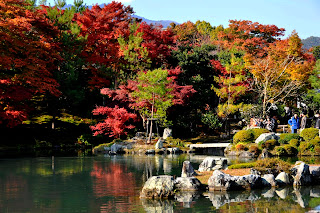
In the gardens, I found out why Japanese gardens always look so neat and tidy: they employ tons of people who constantly clean up the waste that Nature tries to spoil the gardens with!


3 - Okochi Sanso
On the way to this villa, I pass through the famous Arashiyama bamboo grove. I like the atmosphere inside a bamboo grove. It's like being in a forest, but in a very light and elegant one.

The entrance fee to the villa included green tea and a small sweet, providing me with a very welcome five-minute break.

The villa's gardens were beautifully designed and not too crowded (a very welcome alternation on this day).


4 - Jojakko-ji
Another temple sporting gorgeous autumn colors and, being located on a hill on the outskirts, a nice view over Kyoto.


5 - Nison-in
This temple has a large graveyard on its grounds where some famous poet is supposed to be buried. It also featured crowds at the usual (autumn-colored) spots.


6 - Ryoan-ji
Finally, a short tram ride later, the last temple (and second World Heritage Site) for today. The most famous part is its garden featuring several rocks scattered over a neatly raked gravel bed. Apparently, the designer didn't bother to explain whether it has some kind of meaning or not. The temple also has a pond with beautifully colored trees at its shore.


The hard facts:
- visited 5 temples and 1 villa, of which 2 are UNESCO World Heritage Sites
- paid 1650 Yen transportation
- paid 3300 Yen admission fees
- tried to walk a little less today, but had only limited success (12.5 km, have a look at the track)
away), rinse, repeat.
1 - Tofuku-ji
Apparently, this temple is THE most popular autumn foliage spot in Kyoto. And, I have to admit, it did really look beautiful - just have a look at the pictures below. The crowds, however, were crazy. I had worried about finding the temple because it is a 10 minute walk from the train station - but there was a constant stream of people heading there, so no problem at all. The queue in front of the ticket counter was impressive, and inside it was like one big queue around all the best spots.


The green parts of the temple were pretty empty, so I could have a good look at the gate (see below), which is supposed to be the oldest temple gate in Japan. On my way back, I stopped at one of the good viewpoints to take some more pictures when somebody in a uniform approaches me, gestures wildly and shouts "No photo"! I left because I was done anyway, but still I was confused - everybody was taking pictures at that spot. WTF??

2 - Tenryu-ji
Back to the train station, and one trip through Kyoto later, I arrived at this Word Heritage Site which is famous for its Zen gardens. Thus, I only visited the garden and didn't go inside the temple.

In the gardens, I found out why Japanese gardens always look so neat and tidy: they employ tons of people who constantly clean up the waste that Nature tries to spoil the gardens with!


3 - Okochi Sanso
On the way to this villa, I pass through the famous Arashiyama bamboo grove. I like the atmosphere inside a bamboo grove. It's like being in a forest, but in a very light and elegant one.

The entrance fee to the villa included green tea and a small sweet, providing me with a very welcome five-minute break.

The villa's gardens were beautifully designed and not too crowded (a very welcome alternation on this day).


4 - Jojakko-ji
Another temple sporting gorgeous autumn colors and, being located on a hill on the outskirts, a nice view over Kyoto.


5 - Nison-in
This temple has a large graveyard on its grounds where some famous poet is supposed to be buried. It also featured crowds at the usual (autumn-colored) spots.

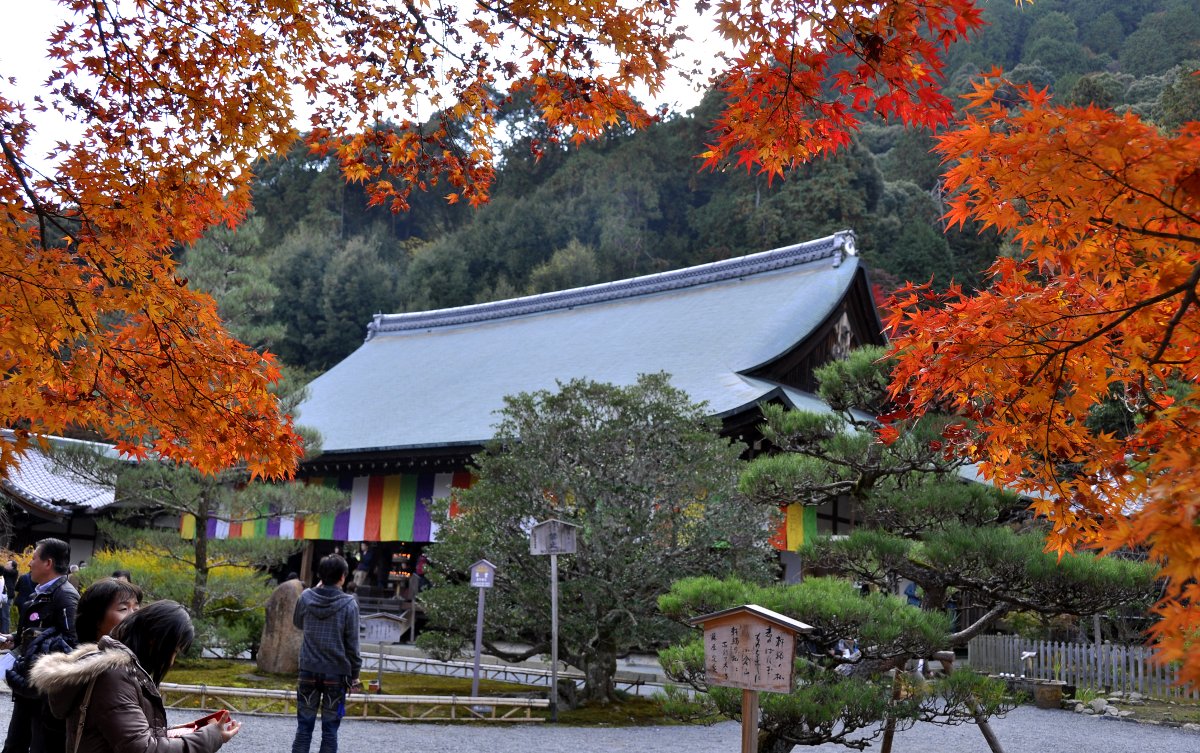
6 - Ryoan-ji
Finally, a short tram ride later, the last temple (and second World Heritage Site) for today. The most famous part is its garden featuring several rocks scattered over a neatly raked gravel bed. Apparently, the designer didn't bother to explain whether it has some kind of meaning or not. The temple also has a pond with beautifully colored trees at its shore.


Friday, November 19, 2010
Kyoto
On Saturday, it was time for my first sightseeing trip. Originally, I had planned to visit Himeji castle, but as I heard in the lab that it is undergoing renovations right now, I went to Kyoto instead.
The hard facts:
This was the first ever sightseeing trip where I recorded a GPS track - now I know for sure why sightseeing is so damn exhausting! You just walk and walk and the kilometers accumulate and at the end you have covered a distance that you wouldn't want to cover in your daily workout.
I took a local train from Osaka to Kyoto (because local trains are much cheaper than express trains, such as the Shinkansen, and it still only took about 45 minutes). The first thing I did when I arrived was to check the tourist information center in Kyoto station. It wasn't very useful because it was very much geared towards Japanese tourists (i.e. there was no information in English available at all). However, I found one poster which I thought was very funny. It contained a detailed list of sights and places in Kyoto, indicating for each the current status of the autumn foliage using green and red maple leafs. I took the trouble to look for one specific place that I had planned to go to because the travel guide said it was one of the most beautiful places to visit in autumn. I found it after much comparing of Japanese characters on the poster with the ones in my travel guide, but it only had two green maple leafs and no red ones. So I didn't go there - I'll probably check again the next weekend.
1 - Higashi Hongan-ji
After leaving the station, I walked a little north to visit my first temple, Higashi Hongan-ji. I have to say, I wasn't very impressed by this temple, although it apparently is one of the largest wooden buildings in the world. A common trait of most temples in Japan seems to be that they were repeatedly destroyed by fires, and thus the current buildings are all reconstructions of the original ones - that's probably the main reason why there are so many "No Smoking" signs all over the temples. In the case of Higashi Hongan-ji, the latest reconstruction was done in 1895. To aid the reconstruction, followers of the temple donated hair to make ropes that were used to lift the wooden beams. One of these ropes is exhibited in a glass case inside the temple.


2 - Nishi Hongan-ji
On to the second temple, and the first World Heritage Site in my visit. This one is a little bigger than the one before, and more impressive.


There also seemed to be a wedding taking place in the temple, and I took pictures of the bride and groom being prepared for the group photo.


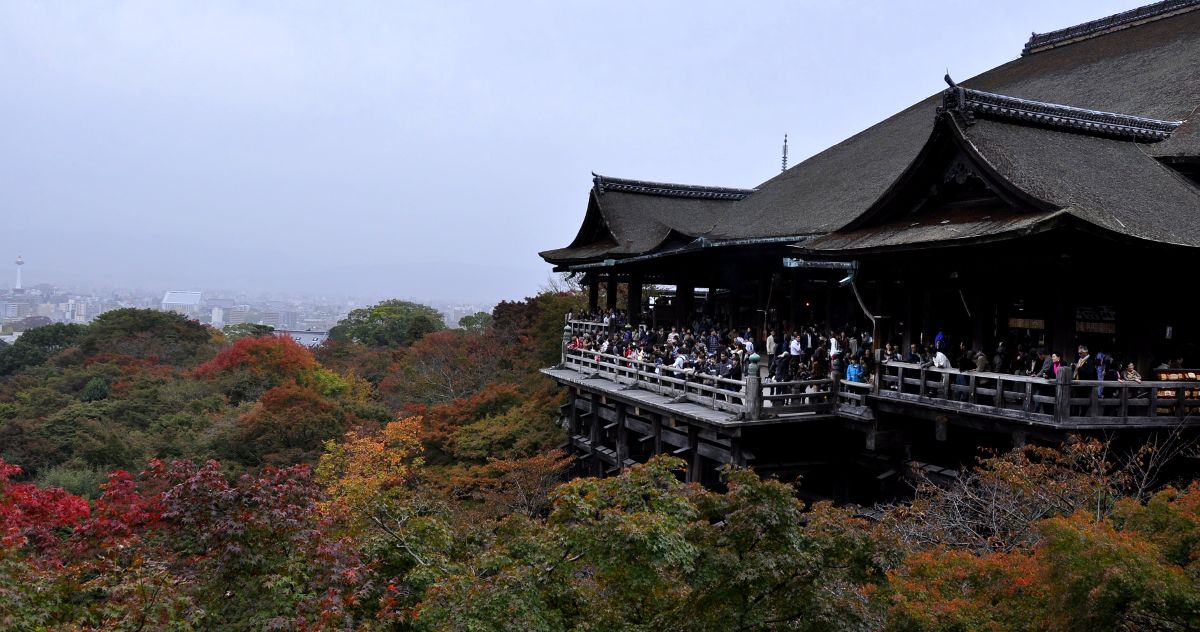
3 - Kiyomizu-dera
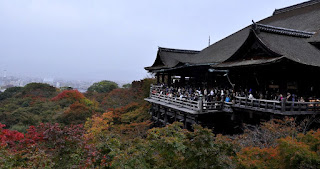
The third temple, and second World Heritage Site, is the biggest of the temples today, and very crowded. There are various temple halls and shrines on the extensive grounds, and the visitors are led in a fairly fixed course through all of it.


Apparently, rubbing all kinds of statues brings luck, or answers prayers, or something. That's the reason why the one in the picture below is so polished.

At one place, there is a waterfall where people queue to get a drink from its sacred waters. I took a couple of pictures of how two Japanese girls in traditional clothing did it.

4 - Kodai-ji
Starting at this temple, my memory starts to blur a little. Maybe it would be better to visit less temples in one day, and instead throw in a castle for good measure...


5 - Maruyama-koen
This is a park you pass on the way from Kodai-ji to Shoren-in. To be honest, I was already fairly tired at this point, so I didn't really explore the park. Maybe I'll come back in spring, as this park is allegedly one of the most popular spots for cherry blossom viewing.
6 - Shoren-in
After the park, I had planned to visit another temple, Chion-in. However, it was already closed (it was only 4pm - wtf?), so I went on to Shoren-in. This was actually quite nice because it wasn't very crowded and the walking tour in the temple and temple grounds was well laid-out. I'll have to explain this a little bit. In all temples, you have to remove your shoes before entering any building. Most temples provide plastic bags for you to carry your shoes with you until you leave the building again. So that's where I run out of hands because there's the travel guide in one hand, and I need the other to operate my camera. That's why I don't appreciate it when I also have to carry my shoes with me. In Shoren-in, however, they have a shoe-rack at the entrance where you can leave your shoes, then take the tour around the interconnected buildings, then return to the entrance, put on your shoes, and take the tour around the temple grounds. In addition, they have some very fine painted sliding doors from the 16th century, and I also found the general atmosphere to be very nice and tranquil. So that was a beautiful ending to my first day of sightseeing.


The hard facts:
- visited 5 temples and 1 park, of which 2 are UNESCO World Heritage Sites
- paid 1500 ¥ for admission fees
- paid 1420 ¥ for transportation
- walked more than 15 km (see the track, but there's a section missing right at the beginning where I forgot to switch on the GPS receiver. I started at the train station, then went to visit the temple directly north of the station, and only then went to the temple in the west where the track starts)
This was the first ever sightseeing trip where I recorded a GPS track - now I know for sure why sightseeing is so damn exhausting! You just walk and walk and the kilometers accumulate and at the end you have covered a distance that you wouldn't want to cover in your daily workout.
I took a local train from Osaka to Kyoto (because local trains are much cheaper than express trains, such as the Shinkansen, and it still only took about 45 minutes). The first thing I did when I arrived was to check the tourist information center in Kyoto station. It wasn't very useful because it was very much geared towards Japanese tourists (i.e. there was no information in English available at all). However, I found one poster which I thought was very funny. It contained a detailed list of sights and places in Kyoto, indicating for each the current status of the autumn foliage using green and red maple leafs. I took the trouble to look for one specific place that I had planned to go to because the travel guide said it was one of the most beautiful places to visit in autumn. I found it after much comparing of Japanese characters on the poster with the ones in my travel guide, but it only had two green maple leafs and no red ones. So I didn't go there - I'll probably check again the next weekend.
 |
| Poster showing the status of autumn foliage around Kyoto |
After leaving the station, I walked a little north to visit my first temple, Higashi Hongan-ji. I have to say, I wasn't very impressed by this temple, although it apparently is one of the largest wooden buildings in the world. A common trait of most temples in Japan seems to be that they were repeatedly destroyed by fires, and thus the current buildings are all reconstructions of the original ones - that's probably the main reason why there are so many "No Smoking" signs all over the temples. In the case of Higashi Hongan-ji, the latest reconstruction was done in 1895. To aid the reconstruction, followers of the temple donated hair to make ropes that were used to lift the wooden beams. One of these ropes is exhibited in a glass case inside the temple.


2 - Nishi Hongan-ji
On to the second temple, and the first World Heritage Site in my visit. This one is a little bigger than the one before, and more impressive.


There also seemed to be a wedding taking place in the temple, and I took pictures of the bride and groom being prepared for the group photo.


3 - Kiyomizu-dera
The third temple, and second World Heritage Site, is the biggest of the temples today, and very crowded. There are various temple halls and shrines on the extensive grounds, and the visitors are led in a fairly fixed course through all of it.


Apparently, rubbing all kinds of statues brings luck, or answers prayers, or something. That's the reason why the one in the picture below is so polished.

At one place, there is a waterfall where people queue to get a drink from its sacred waters. I took a couple of pictures of how two Japanese girls in traditional clothing did it.


4 - Kodai-ji
Starting at this temple, my memory starts to blur a little. Maybe it would be better to visit less temples in one day, and instead throw in a castle for good measure...


5 - Maruyama-koen
This is a park you pass on the way from Kodai-ji to Shoren-in. To be honest, I was already fairly tired at this point, so I didn't really explore the park. Maybe I'll come back in spring, as this park is allegedly one of the most popular spots for cherry blossom viewing.
6 - Shoren-in
After the park, I had planned to visit another temple, Chion-in. However, it was already closed (it was only 4pm - wtf?), so I went on to Shoren-in. This was actually quite nice because it wasn't very crowded and the walking tour in the temple and temple grounds was well laid-out. I'll have to explain this a little bit. In all temples, you have to remove your shoes before entering any building. Most temples provide plastic bags for you to carry your shoes with you until you leave the building again. So that's where I run out of hands because there's the travel guide in one hand, and I need the other to operate my camera. That's why I don't appreciate it when I also have to carry my shoes with me. In Shoren-in, however, they have a shoe-rack at the entrance where you can leave your shoes, then take the tour around the interconnected buildings, then return to the entrance, put on your shoes, and take the tour around the temple grounds. In addition, they have some very fine painted sliding doors from the 16th century, and I also found the general atmosphere to be very nice and tranquil. So that was a beautiful ending to my first day of sightseeing.


Japan is a Cash Country
In Japan, cash still rules over plastic money - or at least over internationally issued credit cards. Most shops and restaurants do not accept foreign plastic money (I haven't really checked whether they accept Japanese cards, but I haven't seen anyone pay with a card so far). Ticket machines and other vending machines operate with cash only.
Even when it comes to ATMs, not all of them are created equal. Most ATMs do not accept international credit cards. Only those owned by two or three certain banks are connected to the international network. Luckily, the fairly common Japan Post ATMs belong in this category.
I'm even supposed to pay the rent for my apartment in cash. What a strange notion, to carry a wad of cash to the landlord every month.
So, I guess I should feel lucky that I received a part of the allowance for my scholarship in cash today. I believe I've never had such a large amount of cash with me. And without a bank account (I haven't opened one yet) to put it into - where am I going to keep it? Under my pillow?
Even when it comes to ATMs, not all of them are created equal. Most ATMs do not accept international credit cards. Only those owned by two or three certain banks are connected to the international network. Luckily, the fairly common Japan Post ATMs belong in this category.
I'm even supposed to pay the rent for my apartment in cash. What a strange notion, to carry a wad of cash to the landlord every month.
So, I guess I should feel lucky that I received a part of the allowance for my scholarship in cash today. I believe I've never had such a large amount of cash with me. And without a bank account (I haven't opened one yet) to put it into - where am I going to keep it? Under my pillow?
Thursday, November 18, 2010
Light and Dark
Up until recently, I believed that the amount of daylight you get during winter in Osaka is nearly equal to that in Germany. Well, of course that cannot be true since Osaka lies a lot further south: Frankfurt, for example is at about 50°N, while Osaka is at 34°N.
So, I checked how much the difference actually is. Right now, it's about 1 hour and 20 minutes, and on the darkest day of the year (December 22nd) it will be as much as 1 hour and 45 minutes. You can have a look for yourself: here are the sunrise and sunset times for Frankfurt and Osaka.
Anybody who knows how much I hate the darkness in German winters will be able to appreciate just how happy I am to be here right now. And as for the summers (Germany has nearly two hours more daylight on the lightest day), I'll gladly come back to Germany then :-)
So, I checked how much the difference actually is. Right now, it's about 1 hour and 20 minutes, and on the darkest day of the year (December 22nd) it will be as much as 1 hour and 45 minutes. You can have a look for yourself: here are the sunrise and sunset times for Frankfurt and Osaka.
Anybody who knows how much I hate the darkness in German winters will be able to appreciate just how happy I am to be here right now. And as for the summers (Germany has nearly two hours more daylight on the lightest day), I'll gladly come back to Germany then :-)
Wednesday, November 17, 2010
First impressions from the lab
Now that I've been working here for more than a week, I think it's time to share my first impressions of the lab I'm working in.
There is a very convenient shuttle bus from my apartment at Toyonaka campus to the lab at Suita campus. Convenient in this case means that it is free, almost door-to-door (check out the track if you like), and runs three times an hour. Also, the last bus leaves at about 7pm, so that's an incentive to not stay too long in the evenings ;-)
The lab basically consists of three smaller offices (for the professor, associate professor, and secretaries) and one big room where everybody else is sitting. Everybody else means about 20 to 30 people (have a look at the lab members page to see who "everybody else" is).
And, of course, as we are in Japan, it is required that you remove your shoes and put on slippers before entering the lab. Although there are guest slippers available, I bought my own after a couple of days because I just like to wear my own shoes - who knows what kinds of feet the guest slippers have already seen?
My desk sits somewhere in the middle of the room, and it features a snowman carrying a Christmas tree. I'm not really sure why it is there. Maybe they put it there to remind me that it (luckily) won't get cold enough here to see any of that freezing white stuff?

Apparently, there are no real coffee breaks at the lab ("real" meaning those that I got used to in Erlangen, where everybody gathers in the kitchen at a specific time and has coffee together). I'm going to miss those for sure!
Instead, there is a mini-shop inside the lab's big room which is basically just a shelf with goods and a box to put your cash in. This shop features lots of canned coffee (think Red Bull - style cans, just filled with coffee or espresso) and some other stuff, like chocolate bars and instant noodles. In short, everything a PhD student needs to survive so he never, ever has to leave the lab ;-)
So, every once in a while somebody will walk to the shop, return with a can of coffee and maybe stop for a little chat at another person's computer on his way back. And that's it for socializing over coffee (not that I'd understand any of the socializing in Japanese that would be going on).
In addition to the mini-store, the lab is also equipped with a fridge, microwave oven, sofas, and a flat-screen TV. You can see most of this stuff on this picture I made:

There are quite a few non-Japanese members in the lab, especially among the post-docs and assistant professors. The countries they are from include Australia, Korea, Poland, Sri Lanka, Thailand, Turkey, and (of course) Germany. I hate to admit it, but their big advantage over most of the Japanese lab members is that their English is a lot better.
For lunch, most of the lab members either bring food from home and heat it up in the microwave, or eat some of the instant noodles available in the mini-shop. Luckily, there are a few guys who regularly have lunch at one of the university cafeterias available on campus. Having lunch with them is just as funny as the lunch times back in Erlangen always were - I'm feeling really lucky!
There is a very convenient shuttle bus from my apartment at Toyonaka campus to the lab at Suita campus. Convenient in this case means that it is free, almost door-to-door (check out the track if you like), and runs three times an hour. Also, the last bus leaves at about 7pm, so that's an incentive to not stay too long in the evenings ;-)
The lab basically consists of three smaller offices (for the professor, associate professor, and secretaries) and one big room where everybody else is sitting. Everybody else means about 20 to 30 people (have a look at the lab members page to see who "everybody else" is).
And, of course, as we are in Japan, it is required that you remove your shoes and put on slippers before entering the lab. Although there are guest slippers available, I bought my own after a couple of days because I just like to wear my own shoes - who knows what kinds of feet the guest slippers have already seen?
 |
| Aren't they beautiful? ;-) |
My desk sits somewhere in the middle of the room, and it features a snowman carrying a Christmas tree. I'm not really sure why it is there. Maybe they put it there to remind me that it (luckily) won't get cold enough here to see any of that freezing white stuff?

Apparently, there are no real coffee breaks at the lab ("real" meaning those that I got used to in Erlangen, where everybody gathers in the kitchen at a specific time and has coffee together). I'm going to miss those for sure!
Instead, there is a mini-shop inside the lab's big room which is basically just a shelf with goods and a box to put your cash in. This shop features lots of canned coffee (think Red Bull - style cans, just filled with coffee or espresso) and some other stuff, like chocolate bars and instant noodles. In short, everything a PhD student needs to survive so he never, ever has to leave the lab ;-)
So, every once in a while somebody will walk to the shop, return with a can of coffee and maybe stop for a little chat at another person's computer on his way back. And that's it for socializing over coffee (not that I'd understand any of the socializing in Japanese that would be going on).
In addition to the mini-store, the lab is also equipped with a fridge, microwave oven, sofas, and a flat-screen TV. You can see most of this stuff on this picture I made:

There are quite a few non-Japanese members in the lab, especially among the post-docs and assistant professors. The countries they are from include Australia, Korea, Poland, Sri Lanka, Thailand, Turkey, and (of course) Germany. I hate to admit it, but their big advantage over most of the Japanese lab members is that their English is a lot better.
For lunch, most of the lab members either bring food from home and heat it up in the microwave, or eat some of the instant noodles available in the mini-shop. Luckily, there are a few guys who regularly have lunch at one of the university cafeterias available on campus. Having lunch with them is just as funny as the lunch times back in Erlangen always were - I'm feeling really lucky!
Subscribe to:
Posts (Atom)