Friday, November 16, 2012

Day 389: My Son

While Hoi An was the Champa's commercial center, their spiritual center was located about an hour's drive inland, at My Son. To avoid having to share the ruins with huge crowds, I decided to book a sunrise tour for my visit. The tour left way too early, of course, but since ours was the only bus going to the ruins for sunrise, it was definitely worth it.

We were even provided with breakfast in the bus: Vietnamese baguette! Apparently, the Vietnamese learned how to make baguettes during French colonization, and now the most prevalent type of bread in Vietnam is baguette. They didn't stop at reproducing French baguettes, however: they made them their own by filling them with Vietnamese-style meat and herbs and sauce. Definitely a culinary experience worth repeating :-)

When we arrived at the ruins, the timing was pretty much perfect, as you can see in this picture:


My Son was the biggest Hindu temple complex in Vietnam. Unfortunately, US carpet bombing during the Vietnam war has destroyed much. This is the best preserved part of My Son - isn't it a shame?


In addition to US bombings, the site has also suffered because many of the more portable relics found there have been shipped off to museums elsewhere in the country. One of the few statues remaining in My Son is this Shiva statue:


Looking at the quality and detail of the carvings that can be seen on building blocks scattered around the site, the temples must once have been a stunning site.


Today, however, the jungle is threatening to retake its territory and cover everything in green fluff.


In some parts of the ruins, a big restoration project was in progress where the destroyed temples were being rebuilt with intact fragments and new bricks, using the same building technology as in the olden days. So who knows, maybe in ten years My Son will have regained its former glory?

Day 388: Hoi An


After a surprisingly relaxing night in a sleeper bus, I arrived in the small town of Hoi An in the morning. Hoi An was the main commercial center of the kingdom of Champa - a civilization that today exists only as a small minority people in Vietnam.

From the 15th century onward, after the decline of Champa, Hoi An was a major port city, but its importance declined in the 19th century when the river got too shallow for big trading ships due to an accumulation of silt. I'm guessing that this may be the reason why the town has not been ruined by new high-rises and port buildings - there was no economic incentive to build modern industry in a port that wasn't functioning anymore.

Consequently, Hoi An consists mainly of small traditional houses built in an architectural style that mixes Chinese, Japanese and Vietnamese elements. The Chinese influence in Hoi An seemed to have been significant: there are assembly halls for five or six different Chinese communities. The Phuc Kien assembly hall is one of them, and the most beautiful of those that I visited:


The inside of the assembly hall's main building was decorated in a way that reminded me very much of my visit to China a few years ago.


To the left and right of the main courtyard were smaller rooms where many of these incense spirals hung from the ceiling:


Each spiral had a yellow card attached to it where people had written messages - mostly asking for things. The ones I could read were pretty shallow, touristy things: good weather, a nice trip, and so on. Most of the cards were in Vietnamese or Chinese, however, and they were probably asking for more significant favors.

Walking on the streets of Hoi An, I noticed again that some parts of Vietnam really cater to Russian tourists. There are signs and restaurant menus either entirely in Russian, or in three to four languages (Vietnamese, Russian, English, and French). I wonder - is this caused by cheap flights available from Russia today, or is it a relic of an old communist friendship?


Some of the traditional houses were open to visitors. This, for example, is Tan Ky house:


The guide who showed us around explained that Hoi An is affected by floods on a regular basis. On one wall, the house had flood markers showing how high the water stood in the past years. The marker on the left-hand side was at about my height and was dated to almost exactly one year ago. A flood like this would have made Hoi An pretty much impossible to visit. Lucky me!


The guide also explained what the inhabitants do in case of a flood: they simply transfer all the furniture to the second floor via a trap door and live upstairs for a while.


Some of the houses had small balconies upstairs that offered nice views of the almost medieval streets:

Monday, November 12, 2012

Day 387: Diving in Nha Trang


The only two things I did yesterday after arriving in Nha Trang was arranging for two dives in the morning, and one bus ticket to Hoi An in the evening. With Nha Trang being the high-rise party town that it is, I didn't really feel the desire to stay longer than absolutely necessary ;-)

The first dive site was quite busy - busy to an extent that I've never seen before. I counted no less than fifteen dive boats anchored at our position! Luckily, we were the first to arrive, so I only noticed the masses of other boats after I got out of the water after the dive.


The dives themselves were beautiful, with lots and lots of coral and reef fish. For much of the first dive, a big trumpetfish swam alongside me - it was amazing to watch how it propelled itself forward with the tiniest of movements. Another thing that was fascinating for me was how much closer I felt to the environment and its inhabitants after the underwater naturalist dive I did for my AOWD certification. What the naturalist dive did was teach me the basic classification of underwater life, some of its characteristics, and the names for some of it. I think it was this ability to identify and name underwater creatures that moved me a big step closer to them, and I really enjoyed classifying them during the dive. For example, I now know that these creatures are called sea squirts - they were very common both in the Philippines and in the dives today.

One thing I've noticed in many countries I've traveled is that many of the locals can't swim. This was particularly absurd in the Philippines where the nearest ocean is never far. But today absurdity got a whole new meaning when I saw these guys:


Apparently people who can't swim nevertheless DO want to dive, and so they get their own personal guide to tow them around. I have to say, I don't really understand. If you're already floating in the water and breathing through a regulator, what is the big difficulty in waving your finned feet around for a bit?


This is the view on the way back to Nha Trang. The blue colors are quite stunning, aren't they? If you look closely, you can see the skyline of Nha Trang in the distance, too:


Sunday, November 11, 2012

Day 386: Easy Riding to Nha Trang

The last day on my Easy Rider tour started with a visit to a rubber plantation. Like all the other rubber plantations I have seen in Vietnam so far, this one was also planted in a very regular, geometric pattern - ensuring good conditions for each tree while maximizing the number of trees in an area, I guess.


Rubber trees, once grown, can be used to harvest rubber from for fifty to sixty years. All you have to do is make a new diagonal cut in the bark every day and attach a small cup to gather the liquid rubber flowing from the tree. This is rubber fresh from the tree:


Another stop we made was at a family that was just processing their cocoa harvest. Cocoa is a relatively recent addition to Vietnam's flora, but more and more farmers are growing it since it yields good money. The processing, like most things in Vietnam, was entirely manual: cracking up the cocoa fruits, extracting the beans and putting them into sacks, and later spreading them out to dry in the front yard. I loved the colors in the pile of cocoa fruits: even though the fruits were all ripe, they had various shades of green, yellow and red.


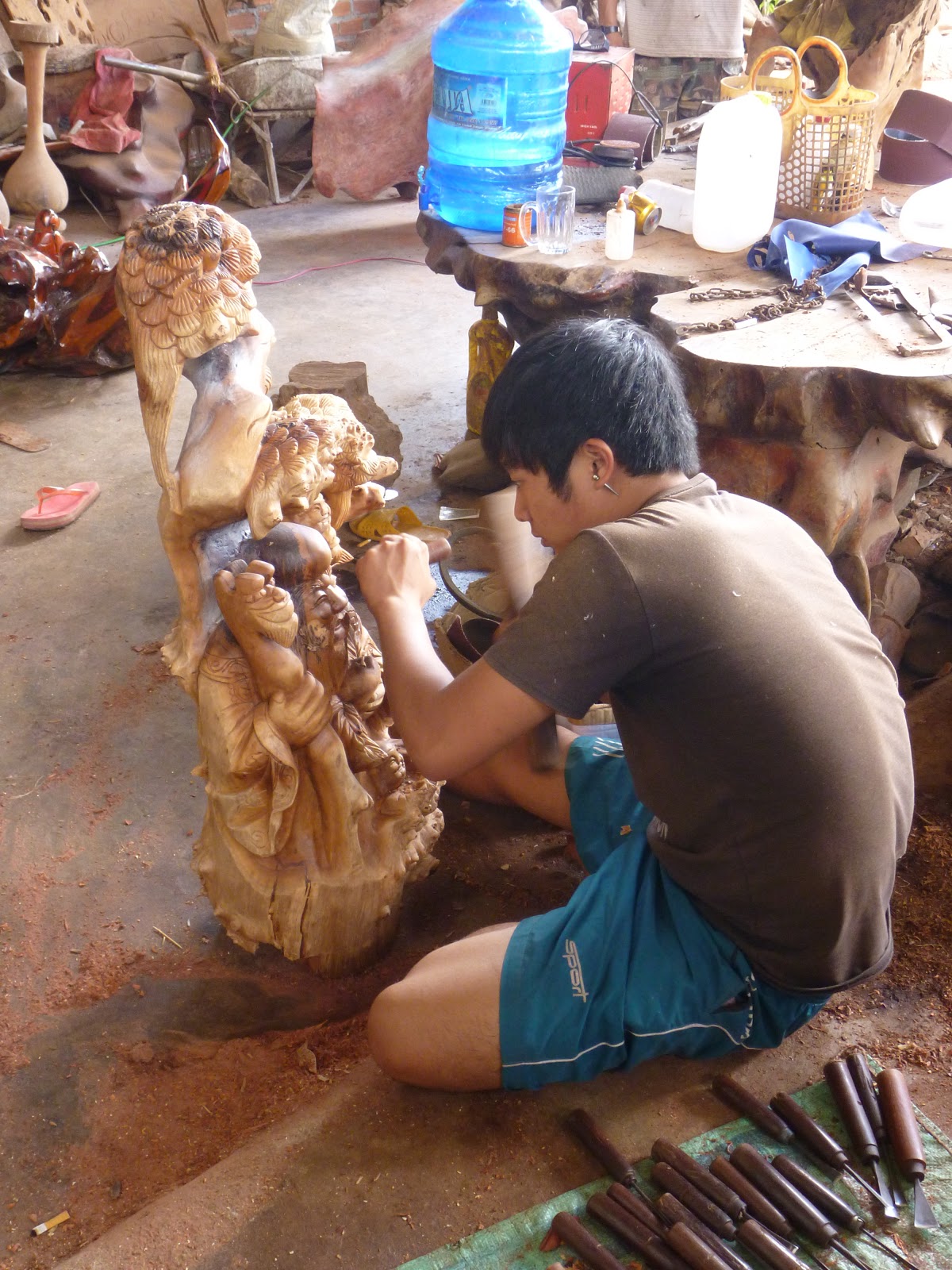
A wood carving workshop was our next stop. The family there uses root wood to carve statues of all kinds, but mostly happy Buddha statues. A statue that takes about two days of work can be sold for three million dong (about 150 US dollars), which is quite expensive for Vietnam, and therefore a good income for the family.


Later, we rode through an area with grassy hills. While the view looks nice and peaceful enough, the reality is not: these were hills that the US sprayed with Agent Orange during the war. Even today, trees that have deep roots cannot grow there; only plants with shallow roots survive. This is just another piece of evidence of how badly Agent Orange has polluted Vietnam.


Just before we rode into the tourist trap of Nha Trang at the end of the day, we stopped at this quaint little fishing village. The high-rise hotels that make up much of Nha Trang seem a world away in this village with its fleet of fishing boats waiting just off the coast.


Day 385: Easy Riding to Buon Ma Thuot

This morning, my guide and I joined up with his father and brother, and their passengers. I hadn't realized before that their office was a family operation - even the two cute kids I had met when booking belonged to the family: they were my guide's daughters. From everything I've seen so far, I got the impression that families in Vietnam are much stronger units than they are in the west.

Our first stop was to explore a minority village close to where we had been staying. The villagers, having originally lived in the jungle, build their houses on stilts as a protection against wild animals. Unlike most other villages, there were almost no women to be seen - they were out working in the forest. In this matriarchal village, the men stay home to cook, clean and look after the kids. The reason, according to my guide, is that women are seen as more powerful because they can control the size of the community with their ability to give birth.


A while later, we passed this ruined church:


As you might imagine, it was bombed during the Vietnam war - hundreds of women and children who were praying there at the time died in the bombing - and the government decided to leave the ruins as a memorial.

We also visited a rice noodle factory. Interestingly enough, the noodles produced here looked completely different from those that I had seen made in the Mekong Delta, and the production process was different, too. The noodles today were made from 100% rice. A machine made the dough into a thin band about 20 cm wide. The band was then cut in wide strips, filled with mushrooms and sometimes meat, and then folded over. The resulting creation is called Banh Cuon, and is eaten - preferably for breakfast - with fried shallots, chili, and fish sauce. Very tasty!

In the afternoon, we had a nature destination waiting for us: the Dray Sap and Gia Long waterfalls. We went to bathe in one of the falls...


... then got back on the motorbike to ride along this narrow jungle path...


... and finally stopped again to see another waterfall from a distance.


A little ride later, we arrived in Buon Ma Thuot, the capital of Vietnam's central highlands. In the war, it was the first southern city to be liberated by the Viet Cong, and as such has even more war memorials than the average Vietnamese city ;-)

Day 384: Easy Riding to Lak Lake

Since my arrival in Vietnam, I had met several people who told me about their amazing motorbike trips with 'the Easy Riders'. My travel guide didn't say anything about them, but the reviews online were raving. Since the tours are very popular, there are many agencies and freelancers offering tours under the same name. Many of them chat up tourists on the street and try to get them to book a tour right then and there. As a solo woman traveler, that didn't seem like the right thing to do, and so I looked for an agency that actually had an office.

I decided to book a three day trip that would take me from Dalat to Nha Trang - a four hour bus ride, if you use the highway and look neither left nor right. Since looking left and right, and stopping often, was the whole purpose of the trip, expanding it to three days seemed like a good idea.

This is my driver Hiep and me in front of the office, seconds before we left:


The first stop was the Truc Lam temple, a Buddhist pagoda just outside of Dalat. The setting away from the business of the city in a pine forest made the temple very calm and peaceful.


There were very few tourists visiting the temple, and the only sound was a harmony of birdsong, wind chimes, and the occasional gong struck by a monk. If there hadn't been an Easy Rider and a day full of adventures waiting for me, I would have stayed for a few hours just to soak up the atmosphere.


But, alas, adventure called, and soon we were in a new village. The village was nicknamed "mushroom village" because almost everybody there farms mushrooms - cloud ear fungus, to be precise. The fungi are grown on bags filled with sawdust inside dark tents, and laid out to dry after the harvest. This way, the mushrooms keep for a long time. To use dried mushrooms for cooking, all you have to do is soak them in water for a little bit, and they're as good as new again.


On the road, we passed several communities harvesting rice - in this part of Vietnam, there are three rice harvests per year, and apparently right now is one of them. I love the yellow-green color of rice fields just before the harvest:


In one of the towns we passed, I saw a huge monument and asked my driver to stop and explain. For him, the monument was nothing special, because there are similar ones in just about every town in Vietnam. They're war hero monuments, of course, commemorating the losses during the Vietnam war and the final victory. I was a bit mystified by the closed gates, but apparently they are intended to keep water buffaloes (and youths) from coming in and abusing the site.


The views all along the road continued to be spectacular. Vietnam really is a gorgeous country!


At one point, we saw a beautiful rainbow resting in the fog on the mountainside. My guide explained that rainbows are the paths where people who are reborn as gods walk up to heaven after their burial - making a rainbow a very special and happy sight.


Rice wasn't the only crop ready for harvesting: in all the villages lining our road, on all available surfaces around the houses and on the side of the road, families had spread out their coffee harvest to dry. Where the big plantations in South America use machinery, family farms in Vietnam do everything manually - or, in this case, let the sun do the work for them.


To my delight, coffee was not only ready for harvesting, but some of the plants were already blooming again. I had never seen coffee flowers before. Beautiful!


Our last stop before we reached our hotel for the night was a bridge crossing an artificial lake that was created by a dam for hydroelectric power generation. The lake is home to a few families living in floating houses. The families originally came from the Mekong Delta - that's why there were used to living on the water - and they came to the highlands because the living conditions on the new lake seemed better.


Although they have houses and plenty of fish, they lack electricity and access to schools. Apropos schools: education in Vietnam is expensive. Every single school costs money - even primary schools. So if a family doesn't have money, the children have no chance whatsoever to get even the most basic education. This is something I definitely wouldn't have expected to find in a country that calls itself a Socialist Republic.

Friday, November 9, 2012

Day 383: Dalat

Today I wanted to take a slow day - I was still processing all the new things I learned yesterday. I therefore started the day with a visit to Dalat's flower park. They had all kinds of colorful flowers, and also funny green sculptures, like these two teapots:


This was a tree whose flowers had an amazing deep red color - anyone know what the tree is called?


Next, I went to look at the train station - Vietnam's oldest, apparently. The station is an Art Deco building with a few old locomotives in the back. As I found out, it seems to be a popular spot for wedding photography. In Vietnam, couples have wedding pictures made before the actual wedding, so that the entrance to the wedding party's location can be decorated with a huge print of the couple in their wedding outfit.

When I was there, a photographer was sitting on a wall, shouting commands at the couple who then changed their postures accordingly. Whenever the photographer was satisfied with the posture, he took a few shots and then started shouting new commands immediately. I left after watching for a few minutes, so I don't know how long the photography session took; judging by the patient looks on the couple's faces, however, it seemed to be a lengthy procedure.


My last stop for the day was the crazy house. The crazy house was designed by a Vietnamese architect who wanted to emphasize the connection between people and their natural environment. Parts of the building are therefore shaped like animals or plants, and there are high walkways connecting the various parts. The overall appearance is that of a crazy mixture of shapes, colors and styles - and that's probably where its name came from ;-)