Friday, November 9, 2012

Day 382: Exploring the Countryside

Today I joined a day trip to explore the countryside around Dalat. Two things made this trip special. First, we were riding on motorbikes - shouldn't be a big surprise, since everybody rides motorbikes in Vietnam. (The reason for this is that the government imposes a hefty 200% tax on car purchases - buy one for you, give two to the government - making cars really expensive.) And second, our guide was not only a local to mainstream Vietnam, but also to the hill tribe we were going to visit: his mother being Vietnamese, and his father coming from the hill tribe. Since the hill tribes have their own language and don't necessarily speak Vietnamese, it was a great advantage that he was fluent in both languages.

I didn't ride the motorbike myself, of course - plunging myself into Vietnamese traffic without any experience driving motorcycles wouldn't have been fun. Instead, I rode on the back of the bike of one of the guide's cousins. After experiencing the feeling of freedom on a motorbike, I think I now understand why people drive motorcycles - it's great! Compared to a car or bus, you get to experience the surrounding nature in a much more immediate way. Plus, feeling the air rush around your face and seeing the green landscape speed by is simply amazing.

Our first stop was a cricket farm. Crickets are considered a delicacy in Vietnam, but not many people farm them purposely. The crickets were kept in open cages with lots and lots of dry leaves and branches inside. Whenever someone came too close to one of the cages, the crickets panicked and started moving around, making an amazing rustling sound that seemed to come from everywhere at once. When the crickets are big enough to be eaten, they are first killed in hot water and then fried in oil and eaten with chili sauce. Of course, we got to try:


I have to say, the crickets weren't half bad! Definitely better than many of the snacks you can buy in western supermarkets.

Our next stop was a local market. The market offered all kinds of food, but also other items, such as these sets of paper clothing, cigarettes, cell phones, and other goodies:


Our guide explained that the Vietnamese culture puts a lot of emphasis on remembering the dead. Therefore, on the anniversary of somebody's death, their relatives buy paper gifts and burn them to send them to the dead. As Buddhists, the Vietnamese believe in rebirth, and thus these offerings can be seen as a way of wishing the ancestors well in their new lives. The gifts can represent anything that you'd like your deceased relatives to have: clothing, motorbikes, cars, and even iPads.

A short ride after the market, we stopped at a small factory that produces silk - or rather, that shamelessly exploits the silkworm's tendency to spin silk cocoons ;-)

The families in the factory's neighborhood breed silkworms and then sell the cocoons to the factory. The factory stores the cocoons like this before processing them further:


In the next step, the worms - which at this point are sleeping inside the cocoons - are killed in hot water and the cocoons are unwrapped to produce silk thread. The unwrapping is mostly done by machines, but the cocoons have to be hooked up to the machine one by one, so there is quite a lot of human involvement necessary.


Our next stop was a nice contrast to all the cultural information before: the elephant waterfall is a massive downpour of water. The cool thing is that you can climb down and approach it from the side. It's too wet and windy down there to go behind the waterfall, but even from the side the view is spectacular.


Then, on the way to our guide's native village, we stopped at a viewpoint where we could admire the Vietnamese highlands. Much of the highlands is covered with coffee plantations. Coffee is a lucrative crop, and so the highlands are comparatively rich. What I found amazing was that the plantations are owned by families. Big companies only come into play when it comes to roasting coffee, so much of the profit actually stays with the local people.


Close to the village, we found that a couple of families were in the process of harvesting rice. The harvest is always a community effort - everybody helps harvesting their neighbors' fields, and in turn the neighbors help with everybody's harvest, too.

There are many steps in the harvest, and women and men both contribute. Cutting the rice is done by the women; collecting bundles of rice and carrying them to the thresher is done by the men; filling rice into sacks is women's work, putting hay onto a truck men's work.


After watching the harvest for a while, we had lunch in the village, and then went to visit a local family in their house. We met the 60-something mother with four of her grown daughters. The youngest daughter, about thirty years old, had grandchildren already. Grandchildren! She said she was married at ten and had her first child with fourteen.

Marriage in this particular hill tribe is always arranged; the girl's family has to buy a boy for their daughter, and after the marriage the husband comes to live with the wife's family. An inexpensive husband - one that isn't particularly strong, or one that drinks and smokes - costs about one buffalo (worth roughly 700 US dollars), while an expensive one may cost five or more buffaloes. The family we visited was quite poor, so they didn't have enough money to buy a husband for each of their daughters. As a result, only two of the four daughters are married. Since there is no way for two people to get together other than marriage, the other two daughters are missing out on sex life - for their entire life, in all probability.

Aside from marriage customs, the family told us about many aspects of their lives: what they eat (mainly rice), where they sleep (on the floor, with pretty much everybody in the same room), and what they do all day - make cotton threads and weave colorful skirts, for example:


After we left the family's house, our guide told us more about customs in mainstream Vietnamese culture. In marriage, for example, a girl goes to live with the husband's family. The society seems to put huge pressure on girls to get married before they turn thirty, and then to produce offspring as soon as possible, ideally within one or two years of the wedding. Weddings are big and expensive affairs. The couples generally have two huge parties, one for the wife's family and friends and another for the husband's. Each party has at least a few hundred guests, who are all provided with food and drink - you can guess that weddings put quite a strain on a family's finances.

The beauty ideal in Vietnam encompasses everything that the average Vietnamese person is not: white skin, a westerner's frog eyes and big nose, and 'noodle soup', i.e. curly hair. I'm guessing we have cosmetics companies and plastic surgeons to thank for this; they earn a fortune selling skin whiteners and eye and nose surgeries to Vietnamese people.

Our guide also told us about the pitfalls of the Vietnamese language. Like Chinese, Vietnamese is a language that uses tones in addition to sounds. These tones are not always easily audible or reproducible by foreigners. A slight mispronunciation can turn 'thank you' into an insult - what a minefield!

Monday, November 5, 2012

Day 381: To Dalat


Today I took an early bus from Ho Chi Minh City to Dalat, a town in the Vietnamese highlands. The bus company had predicted that the bus would take about six hours; in reality, however, the journey took us close to eight hours. I had the dubious luck of sitting right behind the driver - in a country where it is customary to honk at most motorbikes just before you overtake them, that's a seat your ears and nerves definitely don't want to have. My solution was simply to listen to loud music for much of the journey, but that didn't help the slow progress we were making and the often reckless overtaking maneuvers I saw the driver make.

Anyway, we made it safely to Dalat in the late afternoon, maybe an hour before nightfall. Not enough time to do anything more substantial than check into my hotel, find something to eat, and make plans for tomorrow.

Day 380: Cooking in Saigon


Being in a country with such amazing food as Vietnam, I had to try and take home a few secrets - and the best way to do this seemed to be a cooking class.

Before we could start cooking, we went to visit the local market to buy ingredients. In Vietnamese markets, it's all about freshness. That's why prices are higher in the morning, and fish vendors have water bowls with live fish that are only killed on demand.

We didn't buy any fruits, but the colors and presentation were amazing. Note the huge green grapefruit in the middle, and the colorful dragonfruit to the left.


The restaurant was very well prepared for cooking classes. They had two tables set up, one for cooking, with utensils and ingredients neatly laid out, and the other for eating, with cutlery and drinks. While we were eating the first course, the helpers cleaned the cooking table and set out everything we would need to make the second course. Cooking can be so relaxing when you don't have to worry about cleaning up!


The first course we made was a vegetable salad rolled in a mustard leaf and topped with prawns. We also made a sauce to dip the rolls into, consisting of a mixture of kumquat juice, fish sauce, garlic, chili, and sugar. Yum!


We also made fried rice balls stuffed with pork, and rice noodles with BBQ pork. The food was very, very good, but unfortunately none of the three courses was simple enough that I would dare to replicate the dish at home. I think the amount of preparation that the kitchen helpers did for us would easily double the preparation time, and then you'd also need stuff like pots of boiling oil and a barbecue.

After the cooking class, I went on to visit the museum of history. They had exhibits starting from the paleolithic age up until the 20th century, stopping just before the Vietnam war. The museum was quite interesting, but not particularly well done, and photography wasn't allowed either.

My next stop was therefore much more to my liking: the Saigon art museum was located in a wonderful colonial building, and the artwork was presented in small rooms off a corridor that circled a large courtyard. Many of the exhibits were similar to what was presented in the history museum, with only a small shift of focus from history to art.

This, for example, is a Khmer statue of Buddha from the south of Vietnam - a good indication that I've finally arrived in a country that is not predominantly Catholic ;-)


The artwork presented in the museum ranged from centuries-old Buddha statues to abstract modern art, and covered pretty much everything in between.


Nearly all the exhibits were done by Vietnamese artists - I can't remember ever to have seen work by a Vietnamese artist in any museum I've visited. Isn't it fascinating how a country can produce outstanding art, but nevertheless be all but ignored by museums worldwide?

Sunday, November 4, 2012

Day 379: Mekong Delta - Can Tho

The second day of my Mekong Delta trip started very early. We met at 6am for a tour of the village's market and a visit to the primary school. When we got to the school, about half an hour before lessons started, many of the children were working together sweeping the floors. If someone had asked us to sweep the school's floors back when I was a kid, it's almost impossible to imagine that we would have complied. These kids did so very gracefully, however, and had their fair share of fun and laughter in the process.


After breakfast, we went on another boat trip to visit the floating market. The image I had in my mind when I thought of a floating market was that of a market hall somehow made to float on the river. That was not what the real floating market looked like, of course. Basically, the market consisted of a couple of ships anchoring in a specific area. Each ship had one or a few kinds of goods for sale; to tell potential customers what exactly a ship has aboard, they put up a pole displaying their goods.


The customers went around on their own small boats, or on special taxi boats, to visit the vendor ships and make purchases. Each vendor came to the floating market loaded with cargo, and our guide explained that they would stay until everything was sold. Then they would either buy new wares at this market and move on to another market, or return home to get a new load of their (mostly agricultural) goods.

On the way to and from the floating market, we saw a new face of the city: the riverside face. Hundreds of small shacks were built almost on top of the river, while more modern buildings towered behind. 


After the floating market, we visited a rice noodle factory. The factory visit was pretty good because the factory's products - fresh rice noodles - are sold in big quantities, and only to wholesalers. Therefore, they didn't care about the tourist visitors at all, and we were free to look around and watch rice noodles being produced.

Rice noodles are the main ingredient in Vietnam's popular noodle soup dishes, such as Pho. They are made from a mixture of rice flour and tapioca starch. The factory created a liquid dough from these two ingredients, and then workers made big pancakes that were steamed over boiling water (the water being brought to boil by burning rice husks - nothing is wasted here).


The pancakes were then laid out to dry on bamboo mats, and piled up once they were dry. 


In the last step, the dried pancakes were put through a cutting machine and packaged. The cutting machine was the only bit of machinery in the entire factory. Everything else - making the dough and pancakes, arranging pancakes on bamboo mats and in piles, and packaging the cut noodles - was done manually.

Saturday, November 3, 2012

Day 378: Mekong Delta - My Tho

Today I joined a two-day trip to the Mekong Delta, southwest of Ho Chi Min City. The trip was a very touristy affair, leading us to place after place, all of which obviously existed only for the benefit of the tourist. Everything was joined together by boat trips on different branches of the Mekong river. But even, or especially, the boat trips were very, very touristy. Just have a look at this small canal and the traffic jam caused by tourist boats:


In the course of the day, we drank Longan honey tea, learned how coconut candy is made, enjoyed local fruits - jackfruit, longan, dragonfruit, and sapoche - and listened to some local music. All broken up into nice tourist-sized bites, of course, so that nobody was in any danger of feeling overwhelmed by new information and impressions.

In the late afternoon, after two more hours in a bus and ten long minutes on the back of a motorcycle, we arrived at the place where we would spend the night. Advertised as a "homestay," it really was more of a small family-run guesthouse, located directly next to the river.


Before dinner, we got to participate in the cooking for a little bit: we were allowed to make spring rolls out of thin rice wafers and a filling of beans and tapioca (I think). This is the result of our combined effort, just before everything went into the frying pan:


Like so much food in Vietnam, the spring rolls were simply delicious!

Day 377: War Remnants Museum

The only thing I felt inclined to do today was a visit to the war remnants museum. The museum collects and exhibits all kinds of remnants from the Vietnam war. These included all kinds of weapons: guns, mines, bombs, planes, helicopters, etc. But the biggest and in my opinion most fascinating part of the exhibition was the collection of photographs.

In so many respects, the Vietnam war brought out the worst in humankind. For example, have a look at the following picture, and especially the grinning guy on the left-hand side.


Then look again - can you make out what the five military guys are doing? It may be a little hard to see, but the description below the picture makes it clear: they were waterboarding the person lying on the ground.

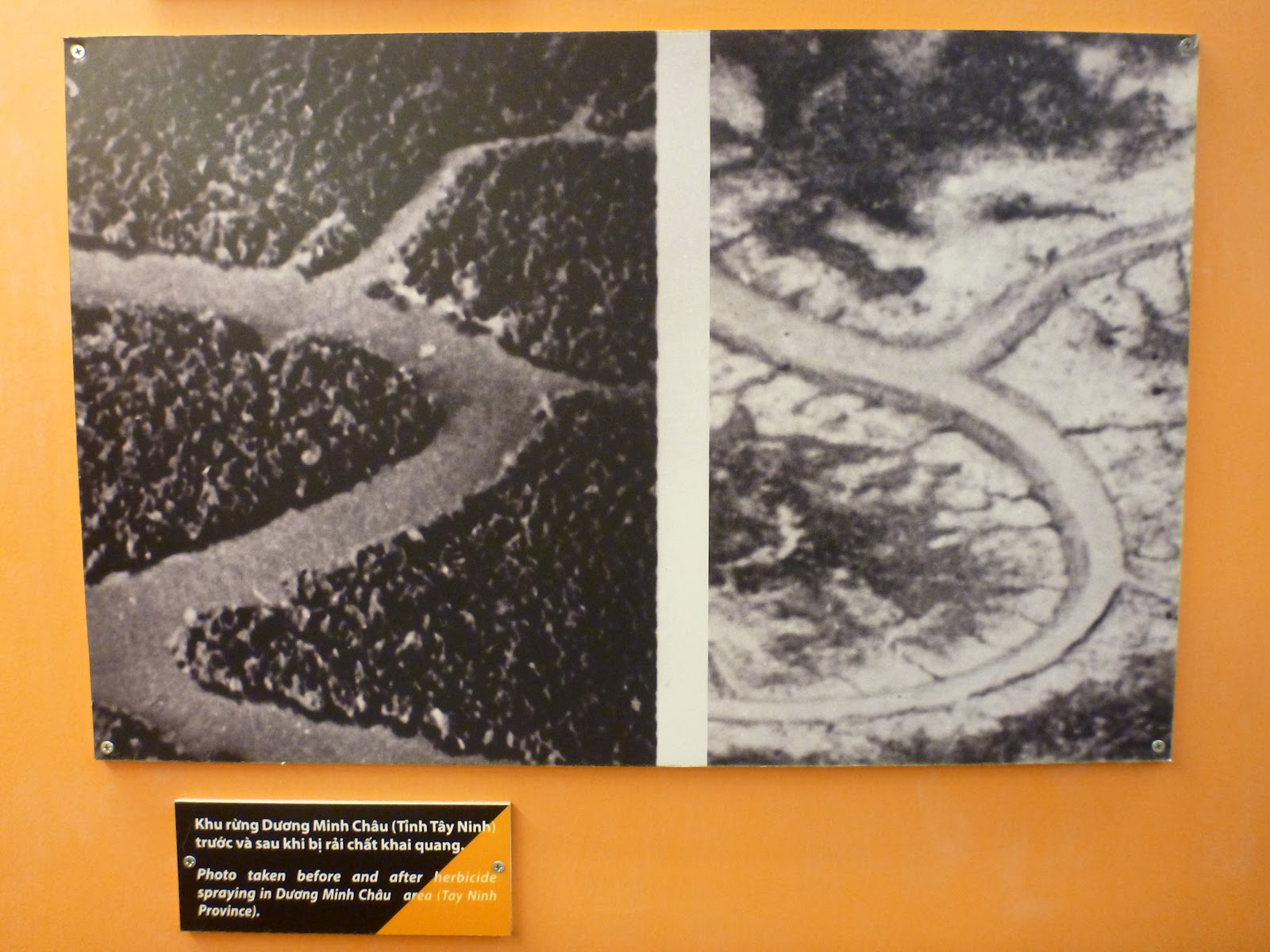
Another atrocity in the Vietnam war was the use of herbicides, most notably Agent Orange. Euphemistically, the US army called the operation in which wide stretches of Vietnam were sprayed with toxic chemicals 'Operation Ranch Hand' - as if the Vietnamese needed someone to help them with their agriculture, and Agent Orange was the warped American idea of farming help. The museum had several photographs of spraying equipment, canisters and planes.


They also had a few before-and-after photographs that showed the drastic effect defoliants had on the vegetation:


To this day, Agent Orange causes illnesses such as cancer, and the birth of deformed children - not only in Vietnam, but in US veterans as well.


The next photograph is a famous one shot by photographer Nick Ut, showing children running from a napalm attack.


Apart from the pictures, the museum also had several bits of information that were new to me. For example, did you know that at its peak, the US army had more than half a million soldiers in Vietnam? Or that the total weight of bombs dropped on Vietnam was almost three times as high as during the entire second world war? Another, particularly ugly bit was that of unprovoked slaughters of entire villages, including (pregnant) women and children. As if slaughtering civilians wasn't bad enough, the people who committed the murders could then go on and become US senators - one of them finally admitted to his crimes in 2001.

In 1953, way before the American involvement in the war, President Eisenhower admitted the true reason for helping the French in the Indochina war they were fighting in Vietnam at the time. Since the US became involved just about ten years later, I'm assuming that this was the real reason for the Vietnam war, too. The reason? It wasn't to keep communism in check, but rather to secure access to Vietnam's deposits of tin and tungsten...

Thursday, November 1, 2012

Day 376: Cao Dai and Cu Chi

Today I joined a tour to visit two sights a little north of Ho Chi Minh City. Our first stop was the Cao Dai temple. The temple doesn't belong to any of the major religions, but rather serves as headquarters for its own religion, the Cao Dai religion. I had never heard of it before coming to Vietnam, but that may be due to the fact that Cao Dai followers are almost exclusively Vietnamese. The religion is quite recent, founded only in the 1920s, and it seems like a mixture of beliefs taken from other religions. In fact, our guide explained, that mixture was intentional to express the sentiment that humans across all religions should be friends.


From the outside, the temple appeared roughly similar to a Christian church - maybe a little more richly ornamented than your average church:


Inside, the decorations were even more obviously Asian, with a fair share of dragons and serpents lurking on the pillars.


We arrived just in time to witness the noon prayer service. According to our guide, the people wearing white were all lay people; only the ones in red, blue, or yellow robes were monks. Like the religion itself, the ceremony seemed to be a mix of elements taken from various other religions. Even though I wouldn't consider myself an expert on religions, I think I could identify elements from at least three different religions. The use of incense sticks reminded me of Buddhism; the sitting position during prayer and frequent bowing of Islam; and the musicians placed on a balcony at the back of the temple of Christian churches - although the music itself was definitely of Asian origin.


After leaving the temple, we went to visit a sight of a completely different nature: the Cu Chi tunnels. These tunnels, located in southern Vietnam, were used during the Vietnam war by the the army of North Vietnam to hide from the South Vietnamese or American armies, and to move without being noticed by them. North Vietnam emerged as a victor from this war, and so their perspective shapes how the tunnels are presented to the visitors: while Wikipedia gives much attention to the dire living conditions in the tunnels, the presentation on-site focuses almost entirely on their effectiveness.

The entrances to the tunnel system were all very well concealed, and didn't require outside help to maintain their concealment after somebody entered. Their small size definitely helped hiding them - or would you have expected a person to be able to enter a hole this size?


The tunnels were an ingenious system with three layers at different depths, air ventilation shafts hidden in man-made termite hills, and booby-trapped dead ends. Apropos booby traps: there were plenty of traps on the surface, too, to keep the enemy from exploring the jungle. For the local people, the traps were clearly marked on trees a few meters before the trap. If you didn't know the markings, however, you were likely to fall into a pit and be speared by bamboo sticks (in this example, at least; other types of traps had other mechanisms of trapping and inflicting pain):


Another "attraction" on the grounds of Cu Chi was a shooting range where visitors could fire a variety of rifles and machine guns that had been in use during the Vietnam war. I had contemplated taking the opportunity, just for the experience of having once shot a gun, but after I heard the first shots from a distance after entering the tunnel compound I decided I didn't ever want to. Gunshots are a terrifying sound to hear, especially if you're standing in unfamiliar terrain and essentially can't see any further than the next couple of trees. My decision was confirmed again when we got close to the shooting range. In a distance of maybe 10 to 15 meters from the shooters, the shots were incredibly loud - so loud that the first one made me jump in shock.

Just before leaving the Cu Chi tunnel complex, we finally had the chance to pass through a small stretch of tunnel ourselves. The original tunnels were only 50 cm wide and 80 cm high - a small Vietnamese person would have much less difficulty navigating such a tunnel than a tall European. The touristy tunnel stretch has therefore been widened to be 80 cm wide and 130 cm high. Even so, walking is only possible with bent knees and a bent back - crawling might have been more comfortable than that.

There were five exits in the 100 meters of tourist tunnel, to allow people to exit as soon as they've had enough. Just before the final exit, the tunnel suddenly shrank back to its original size, finally forcing me into a crawl. When I got there, the people directly in front of and behind me had already left the tunnel at one of the previous exits, so I couldn't see or hear anybody else. Suddenly I was unsure - was this really the right way? Had I missed a turn? Should I have left at the previous exit? Since turning around was all but impossible, my only option was to press on. I was quite relieved to find the next (and last) exit soon after.


To give you an impression of the tunnel interior, this is a shot from a place where there was a change of levels in the tunnel. Unfortunately, I couldn't get any reference objects in the picture, but the tunnel was not a lot wider than my shoulders, and with 130 cm at its highest point just high enough for a low crouch.


On the way back to Saigon, we saw forests of uniform trees from the bus window, all with a diagonal cut in the stem and a small cup attached just below. It took me a while to figure out what they were, but finally I remembered that the guide had mentioned natural rubber as a major source of income in the region. The first time ever I had seen a rubber plantation!